


I’ll credit Robert Mariani for coining the incisive term dinergoth, but his essay in The New Atlantic, “American Diner Gothic” is too distracted by his personal aesthetic hangups to adequately theorize who dinergoths are, where they came from, and whether the Boomers are truly responsible.
Mariani can only describe the dinergoth in signifiers: sloppy winged eyeliner, extensive tattoos, unconventional piercings, BDSM-inflected clothing, fandom kit. But we can describe the dinergoth condition in simpler terms: it’s the prole drift of the 2010s internet. Do you remember GamerGate? What about NewGrounds? Is the word “SuperWhoLock” an MK Ultra wake word for your subconscious? Remember, much of the culture Mariani ascribes to dinergoths peaked between 2008 and 2017. Archive of Our Own launched in 2009. The first Pizzamas (courtesy Hank and John Green) was in 2012. Bladee’s debut mixtape Gluee released in 2014. Undertale released in 2015. Crunchyroll reached 1 million paid subscribers in 2017, and QAnon broke containment the same year. In my college days, I knew people with the very aesthetic Mariani describes as dinergoth, except they went to Bard College.
We are long past the novelty of the aesthetic signifiers now ascribed to the dinergoth. Among “elite” circles,1 it’s passé, a teenage affectation that has since been leavened into adult taste. But we have failed to realize that it’s been ten, twenty years. Twitter poasters have derided as teenage the White House’s recent propaganda video dressing up aerial strike footage as Call of Duty killstreaks. But Call of Duty 4: Modern Warfare was released in 2007. The men who grew up in CoD lobbies are in their thirties and forties. The foot soldiers of GamerGate—on both sides—are middle-aged parents in Natick, Massachusetts; Reston, Virginia; and San Mateo, California.
The terminally-online look—dyed hair, anime kitsch, gender non-conformity—took five, ten, fifteen years and a pandemic to filter into flyover country. That tracks. Nashville picked up on synthesizers about five-ish years after disco took off. That’s how culture works. I can understand Mariani’s distaste for anime, but wasn’t he online ten years ago? How else did he find Nick Land?
The Story Goes Like This
That’s right—Robert Mariani’s little narrative about the New Middle America is a riff on the opening of Nick Land’s 1994 essay “Meltdown,” an abstruse Nostradamus text of the AI age written thirty-plus years ahead of schedule, with prose that reads like a shrink-wrapped pallet of Neuromancer paperbacks fed into a hydraulic press. If you squint, you can see prophetic imagery of high-frequency trading, social media brainrot, AI psychosis, hyperpop, politics-by-kayfabe, Beijing’s embrace of technocapital, tent cities in the Tenderloin, and OSINT psyops. The primary factual error is that Land names Los Angeles as the host of the metrophage, when in fact San Francisco became the nexus. It’s a cool essay, but the drug cocktail that revealed this vision to Land failed to clarify the trajectory from 1994 to the post-COVID internet.
But we’re here now, and with hindsight we can trace our footsteps: it was, to a large extent, revealed preference. We largely liked our digital villages and scrolling feeds. We liked the slop, both big-budget and DIY. We preferred our digital friends and 2D lovers to our IRL communities. We concluded that internet life is way better than our real lives. The meatbags took what the invisible hand offered. Some of us (I included) concluded ten years ago that Robert Nozick’s experience machine kicked ass, at least for a while. And as we’re seeing in the backlash to AI slop, many of those meatbags (I included) are walking back those conclusions, seeking out experiences that cannot be experienced through a screen.
Around the same time that Mariani had his dalliance with a woman he’s still not over, I watched CJ the X’s video Bo Burnham vs. Jeff Bezos (2021), a polemic-documentary that better characterizes the lived experience of internet brainrot in a dying nation than Mariani’s essay. I had just been “canceled” for reasons that felt important at the time. And in repeating this video, the fever of my digital derangement broke. I started going outside. I got into road bikes and boutique espresso. I will forever bear the chemical burn scars of 2010s Twitter, but I got out. My soul no longer fits in 160 characters. The dinergoths can escape as well. Capital had its part, downward mobility had its part, but even the most addictive internet panopticons are ultimately products chosen by consumers.
Nick Land might explain how Bleach got to rural Wisconsin—Adult Swim was merely the conduit—but he can’t explain why people liked it.
Rust Belt Gothic
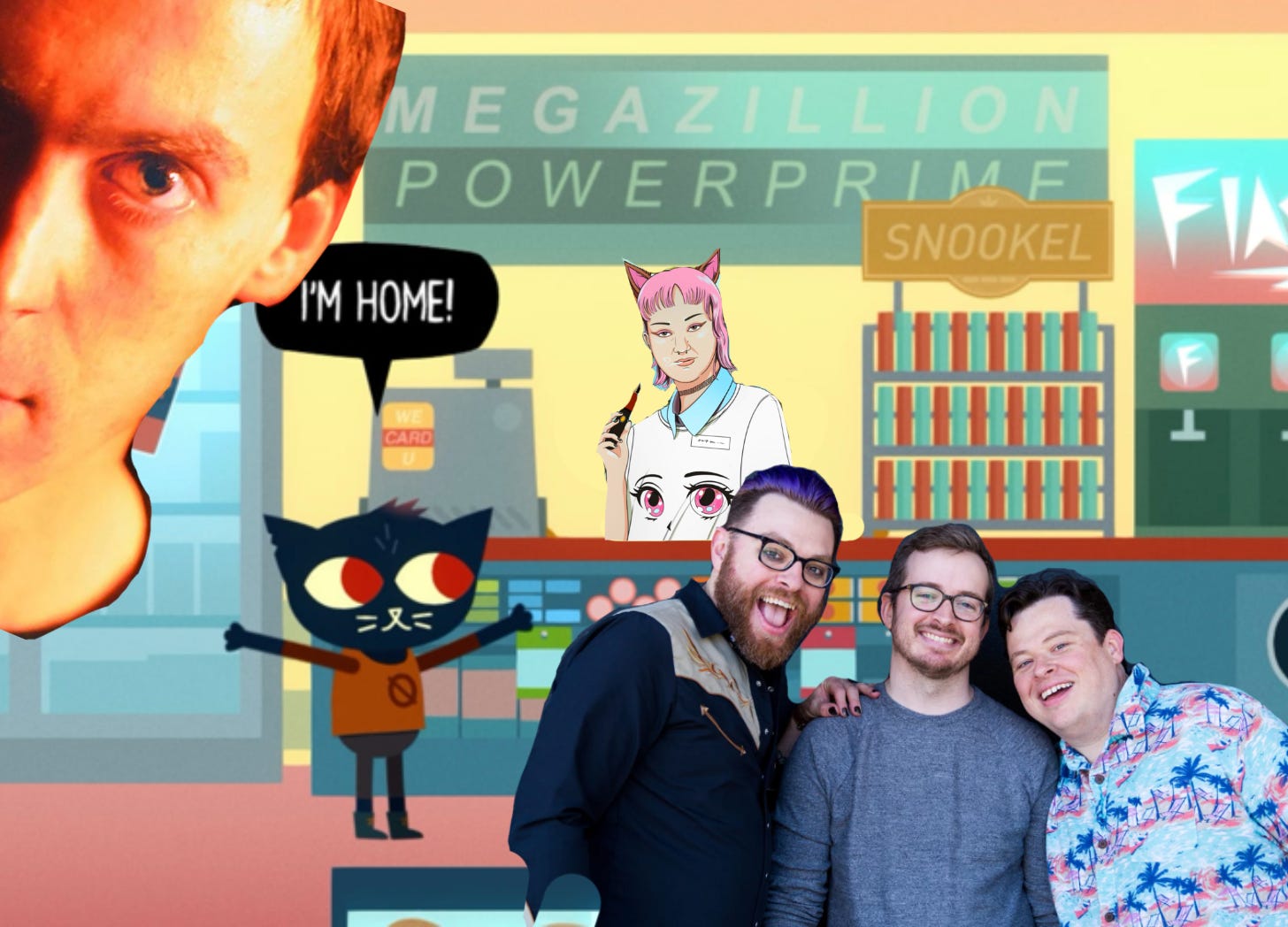
Night in the Woods (2017) ran with the phrase “Rust Belt Gothic” nearly a decade before Robert Mariani applied the term to people dressed like Mae Borowski, Bea Santello, Gregg Lee, and Angus Delaney. Possum Springs is a classically Rust-Belt town: a defunct coal mine, a moldering glass factory, a lingering poverty that a local cult believes can be lifted through live sacrifices to a chthonic entity. The core cast are Very Online precursors to the dinergoth legacy. Bea is a OG goth with an ankh symbol on her dress. Gregg rocks a leather jacket and has a pith helmet with an anarchy sticker on it. Angus’s hat and “annoyingly stident” atheism marks him as a Redditor. And main character Mae rolls around in faded dyed hair, knock-off Doc Martens, and a shopping list of mental illnesses—reminiscent of Mariani’s Portland fling, but in an even more remote corner of the United States. In the Possum Springs of 2017, these friends are anomalous—Mae is returning home from college, and everyone outside the friend group retains a prelapsarian (pre-QAnon, really) small-town demeanor. Mae could trade memes with her friends, but not with anyone else in Possum Springs.
If we want to describe the dinergoth vibe—the dyed hair, the therapy language, the queer identification, the anime fixation—as a mind-virus, Mae brought it to Possum Springs, potentially from her college. And if she didn’t pick up the bug from college, she might have gotten it from people like the McElroy Brothers. These three brothers—Justin, Travis, and Griffin—grew up in Huntington, West Virginia, and have been podcasting since 2010. The McElroys popularized the Dungeons & Dragons actual-play podcast with their show The Adventure Zone. Justin and Griffin co-founded the video game review site Polygon. Travis has become a celebrity among people who play tabletop roleplaying games, and he rolls around in dyed hair and eyeliner. And these sweet, sweet boys are proud Appalachians.
But notably, the McElroys (not to mention the writers of Night in the Woods) did not discover the internet before deindustrialization hollowed out their hometowns. The downward mobility was already baked in. The Boomers didn’t bring Dungeons & Dragons to Kansas City. Private equity didn’t make dyed hair cool.
People like me did—by making board games and Japanese media and deep-fried 808s cool in 2016. Maybe the apprentice electrician in Abilene can’t differentiate the artfully grotesque sexuality of Kill La Kill from the artlessly grotesque sexuality of Eiken. So what he has bad taste—that’s a matter of class.
The New Kitsch and Flash
I am morbidly impressed that Mariani wrote about alternative status games among the downwardly mobile without citing the O.G. analyst of American status, Paul Fussell. The anime stickers and catgirl headbands of the dinergoths are the new kitsch and flash, as W. David Marx framed it in Status and Culture (2022). They’re kitsch in that they have the trappings of high art (it’s Japanese!) without any of the substance of high art, and they’re flash in that they’re loud and obvious and shiny. And that’s fine, actually. Dragon Ball Z does not need to be high art. Not everyone needs good taste.
In fact, Fussell would describe American proletarian culture as a defiant absence of taste. When he wrote Class: A Guide Through the American Status System in 1983, the proles wore purple polyester suits, visible branding, and graphic tees that were sometimes too lewd for polite company. The obvious brands “possess a totemistic power to confer distinction on those who wear them.” The totemistic power of a branded article of clothing continues into the 2020s; only the brands themselves have changed. And now that no one wears suits, the inclinations for loud patterns and overt sexuality now look like purple hair, tattoos, fishnet stockings, and ahegao sweatshirts.
Mariani wants to ascribe this “Cambrian explosion” of melted-down queer, nerd, and goth culture to a collective failure to launch among people born after…let’s say the Berlin Wall. Specifically, Mariani wants to blame the Boomers for taking away our collective American dream to institute Sun Belt Welfare Communism for themselves. But those anime figurines are expensive. Tattoos are expensive. But so are guns and Ford Raptors, and those things sell like hotcakes. Fussell could have told you this—it is possible to be upwardly-mobile and low-class, in much the same way it is possible to be downwardly-mobile and high-class. There’s a correlation, of course, between class and income. But a nurse in Davidson County, Tennessee is better-paid than I am, even if, by my or Mariani’s standards, her art taste is abhorrent.
On Lasell College students in 2016, goth signifiers (and the associated counter-cultural beliefs) were explicit rebellions against pearl-clutching Boomer and Gen X parents. But in 2026, those same signifiers can be defamiliarized and played straight by people who have never heard of an “Anita Sarkeesian.” So what if it’s tacky? It’s fine to be disgusted by the septum piercing on the Buc-ee’s cashier, but twenty years ago, you would have said the same about ear gauges. It’s normal. And in twenty more years, they’ll probably keep the wolf cut—potentially the hair dye too.
Time Keeps Passing
In the same manner Mariani fails to cite Fussell on tacky clothes, he also fails to cite Jean Twenge on his insistence that the dinergoth aesthetic is an outward manifestation of people refusing to grow up. If Mariani wanted the numbers on Zoomers failing to launch, on being slower to pick up jobs and driver’s licenses, Twenge has enlisted herself in the Haidt-Lukianoff “Heterodox” posting pipeline.
And interestingly, some of the purported warning signs of a “woke mind virus” are receding. Queer identification is falling among young adults, per Twenge, and the public opinion on social media (driven in part by backlash against AI) is turning—slowly.
But should a backlash take hold among the dinergoths, we should not expect them to relinquish their hairdos or their hyperpop. People tend to keep the aesthetic signifiers of adolescence and young adulthood, particularly music taste and personal attire. Consider the classic Vsauce video about “retrospective aging” —the teenagers of the ‘80s look old because Gen Xers kept the same hairdos into their 50s. Photoshop a beard and some Warby Parkers onto Norm from Cheers, and he looks like a thirty-something again…to people in the 2020s. The hip slang of the young become the stodgy boomer-isms of the old. The edgy music of teenagers becomes dad-rock with time. Consider: my father got me into Slim Shady. And in time, my children will mock Charli XCX.
I wouldn’t consider the dinergoth look to be a sign of national decline. The poverty of her hometown is a problem, but in the 2020s, the GDP per capita of Mississippi outstrips that of the United Kingdom. The struggles of the towns we can lazily describe as Rust Belt Gothic—drug use, downward mobility, brain drain—are real and endemic. But furry conventions, agate pendants, and Discord fandoms are not proof the country is dying, simply because those aesthetic signifiers signaled wokeness ten years ago.
The forums are mostly gone. 4chan and Tumblr are husks of their old glories. Roosh V found God, Brianna Wu is a centrist now, and Richard Spencer voted for Kamala. The signifiers you remember mean different things now.
And listen—getting your heart broken by an unstable woman with dramatic eyes is a right of passage for a sensitive young man. But those stories are best shared with your closest male friends on a hike.
This writing reflects my views alone, and does not reflect the views of my current employer or previous employers. This is not investment advice.
And by “elite” I do mean “got one-shotted by the internet before everyone else;” this is not exalted company