


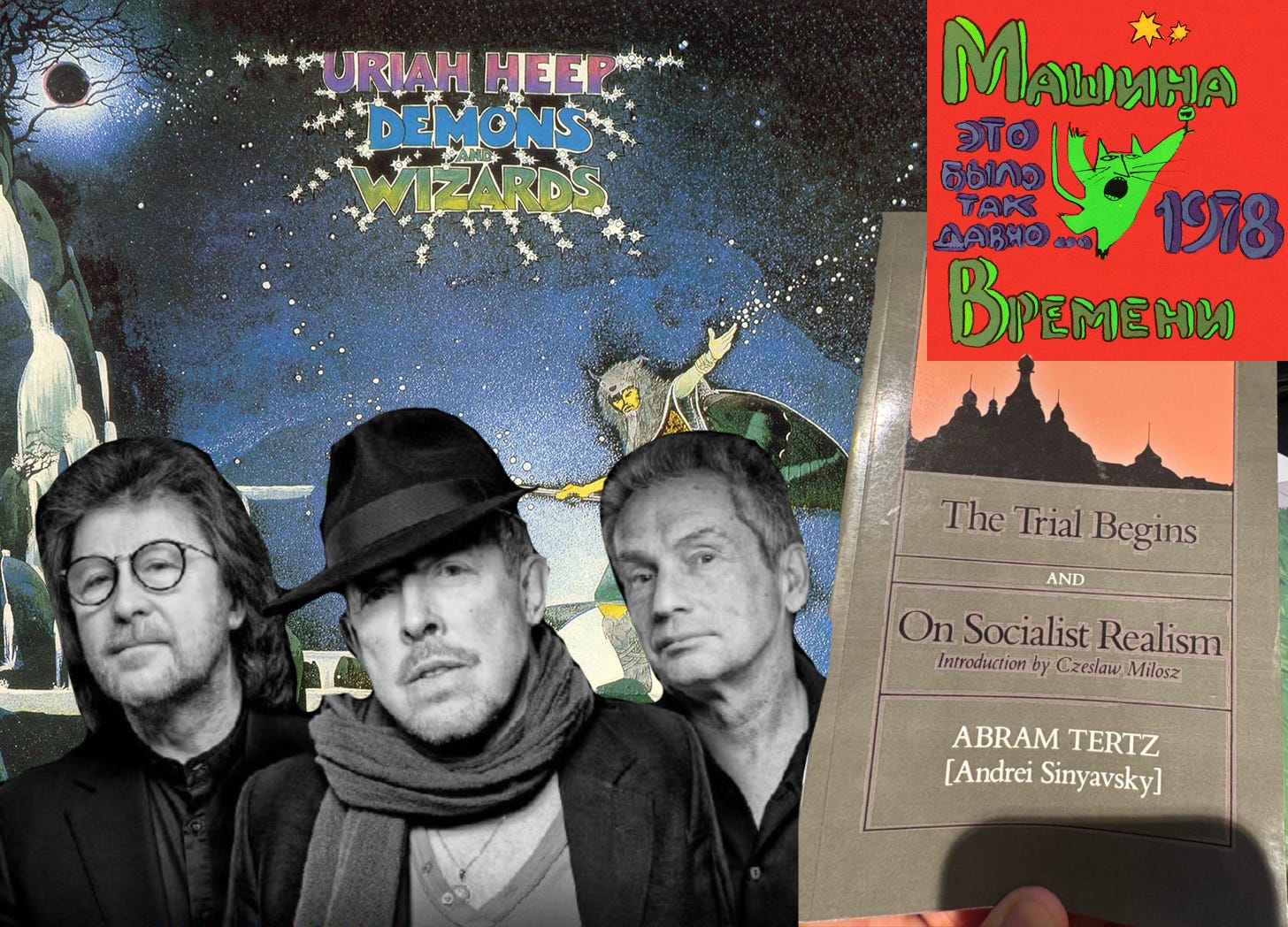
Alexei Yurchak’s history of “the Last Soviet Generation”, Everything Was Forever Until It Was No More (2005), had a chapter on the rock music that suffused Soviet life in the ‘80s. He would know—the Leningrad rock ‘n roll scene of this time were his people. The initial inspirations of rock music came from the West, of course, and Yurchak names the biggest influences: Deep Purple, King Crimson, Pink Floyd, Queen, The Beatles (of course), and…Uriah Heep?
I had never heard of English prog-rock band Uriah Heep prior to reading Yurchak, and they seem to have limited reach in the West. Yet Uriah Heep—not Judas Priest, not Bon Jovi, not even Michael Jackson, Uriah Heep—was the first Western musical act to play in the Soviet Union with the rise of glasnost and perestroika.
Moscow’s Olympic Stadium.
Ten consecutive shows.
One hundred and eighty thousand cumulative attendees.
But who the hell are these guys? Why were they so huge in the USSR, despite their relative obscurity in the West?
A Few Theories
Theory One
Uriah Heep toured in Finland a bunch. Because Finland was forced into “neutrality” by the USSR, (and because Finland was awful close to Leningrad), this was a key inflow of culture from West to East. Bigger bands like the Beatles, Pink Floyd, and Queen entered the Soviet Union through sheer might, in part because authorities were inconsistent about which songs were allowed and which were banned. But hip Soviet youth in the ‘80s were hungry for everything Western—denim jeans, empty Coke bottles, even women’s underwear bought off foreign students. It is entirely feasible that kids bought (and then bootlegged) whatever tapes Finnish sailors brought to Leningrad, and…well, Finland liked Uriah Heep too.
Theory Two
'The Uriah Heep sound was easier to riff on. Soviet electric guitars—particularly the amps—likely weren’t that good. The Soviet electronics industry struggled with miniaturization since the advent of radar. This was more a problem for aviation than for decadent trinkets like guitar amps, but it likely made the meaty sound of Black Sabbath harder to emulate than the lighter amplification and organ riffs of Uriah Heep. At any rate, a lot of underground music was played in friends’ apartments. Truly heavy metal performances were a non-starter in living quarters that were already short on privacy. But an acoustic guitar and a small organ could fit in a kommunalka коммуналка kitchen for a party.
Theory Three
Uriah Heep’s fantasy-driven music, in this case their album Wizards and Demons (1972)1 satisfied a craving for music that did not subscribe to the Soviet state style of art and art criticism: socialist realism.
On Socialist Realism, Briefly
Andrei Sinyavsky’s essay On Socialist Realism (c.1960) gives the gloss, but he starts with the definition provided by the 1934 All-Union Congress of Soviet Writers:
Socialist realism is the basic method of Soviet literature and literary criticism. It demands of the artist the truthful, historically concrete representation of reality in its revolutionary development. Moreover, the truthfulness and historical concreteness of the artistic representation of reality must be linked with the task of ideological transformation and education of workers in the spirit of socialism.
This twin mandate: represent the true and historically concrete, and also advance the revolution with your art, is an offshoot of a core tension in the socialist project. The model Soviet citizen truly is well-read, curious about the world, polymathic, multilingual, and internationalist but not cosmopolitan.2 However, that same Soviet citizen must also be fully convinced on Communism, its efficacy, and its inevitability. In theory, there is no tension, because Lenin was obviously correct and Stalin clearly knew what he was doing. In practice…well…I’ll use Sinyavsky’s example:
If we ask a Westerner why the French Revolution was necessary, we will receive a great many different answers…But if you ask any Soviet school boy—to say nothing of the beneficiaries of our higher education—you will invariably receive the correct and exhaustive reply: the French Revolution was needed to clear the way to Communism.
Remember to keep a Straussian reading on this—Sinyavsky wrote this essay under a pseudonym and eventually got arrested because of this essay. Sinyavsky did not believe that Communism was obviously correct, moral, and inevitable, but that was the state view. And that view, the ideology of Communism, solidified into a religion to replace Christianity, with a grand Purpose, a paradise, and a national telos worth dying horribly for. And by Stalin’s death, it was starting to come together:
Yes, we live in Communism. It resembles our aspirations about as much as the Middle Ages resembled Christ, modern Western man resembles the free superman, and man resembles God. But all the same, there some resemblance, isn’t there?
This proves a problem for the artist, however.
A classical socialist realist work by its nature must push forward the revolution. It must center a positive hero, a shining paragon of the revolution, and it must have a happy ending—happy for the revolution, even if the hero sacrifices themself for the cause. Ambiguity is not tolerated, because ambiguity implies doubt, and to doubt the revolution is to impede the revolution. However, the story must also be concrete and accessible. It must reflect real people, real history, simple stories, because the art must be legible to peasants and directly applicable to the revolution. The fiction must be historical or contemporary, and the historical fiction must draw a clean line to the glorious Communist future.
These are tight constraints to write a story within. It works out fine enough for stories set in the Revolutions of 1905 and 1917, and fantastically for stories set in the Great Patriotic War. Sinyavsky provides Leonid Leonov’s The Russian Forest (1953) as an example. The story, per Sinyavsky, centers a girl named Polya who is sent behind the enemy front in the Second World War. She is supposed to stay undercover among the Nazis, but even pretending not to be a Communist pains her so greatly that she blows her own cover to tell off an officer and demand he show her “the place where Soviet girls are shot.” And this speech rouses a local peasant to immediately shoot the officer, sacrificing himself but saving Polya. This is a ridiculous plot, but it’s probably a page-turner. And I’ve read enough Sarah J. Maas to grant that story doesn’t have to make sense to be a fun read.
But what if the war is over? There is still need for new art, new stories, but the best source of stories that 1) remain realistic and concrete, 2) retain unambiguous adherence to the objectively correct political ideology (hint: it’s Communism), and 3) still got the sauce, has been capped. A socialist realist artist after the War has two options:
Keep to orthodoxy, hammering out nostalgic war stories and squeezing out the last drops of conflict from a now-perfect society.
Diverge from orthodoxy, either by departing from realism to find open narrative space or by implying that life under Communism might not be perfect.
Sinyavsky chose the latter, publishing On Socialist Realism with a companion short story, The Trial Begins (c.1960). Sinyavsky was arrested on 4 September 1965 for these works, which prosecutors alleged were “anti-Soviet agitation.”
The Singing Guitars
Most artists preferred not to be arrested, even if adhering to socialist realism into the Brezhnev years returned broadly sauce-less art. Take the group VIA Poyshchiye Gitary (ВИА Поющие гитары), or The Singing Guitars. This was a Vocal-Instrumental Ensemble Вокально-инструментальный ансамбль that produced state-approved rock n’ roll.
As music, it’s pretty good—primarily late-60s riffs on early-60s Western rock. It’s Beatles-pre-Rubber Soul type shit, and frankly with cleaner production. I’m sure if you were a sixteen-year-old Leningradets ленинградец in 1970, it would be fun enough to dance to and loud enough to offend your parents. But the lyrics to these songs are entirely sauce-less. Young love! Beautiful Sundays! Funny little dudes! Riding your bicycle!
On the remastered compilation I’m working from, the spiciest track is an adaptation of Yevgeny Yevtushenko’s “You’re Leaving, Like a Train Ты уходишь, как поезд”, in which the singer Elena Fyodorova sells the desperate heartbreak of watching your lover leave you.
Even within the tight character limit of a song, The Singing Guitars manage to inject a bit of socialist realism within their goofy songs. “The Cyclist’s Song Песенка велосипедистов” is not only about the joys of riding a bike but also about the technological marvel of a bicycle, unavailable to the primitive man who believed in miracles because he knew not the virtues of the wheel. “The Song is the Main Thing, Friends Песня – это главное, друзья” extols the social value of singing songs, but it compares that value against X-ray beams, motors, and cottage-cheese pies, other things that the glorious Soviet Union needs. And even this We-Have-the-Beatles-at-Home band hammers on wartime nostalgia with a song memorializing the Salaspils concentration camp.
To modern ears, The Singing Guitars make cloying and schmaltzy boomer music, although we must remember what this music sounded like to people who had never heard of the Beatles. Yet the lyrics betray the lack of sauce—The Singing Guitars were still socialist realists, making music that reflected concrete realities and advanced the revolution through family-friendly pop music. This band made Kommunist Kidz Bop tracks that airbrushed the sex, hooliganism, boredom, and (worst) doubt of the youth experience.
Imagine it’s 1975. You’re now twenty-one in Leningrad. You’re growing up, and you’re growing bored of music you know only exists because some fat apparatchik approved it. And then someone hands you a bootlegged copy of Demons and Wizards (1972) on a record made out of old X-ray prints.
The Rainbow Demon
Soviet students did learn some English, but parsing lyrics in a foreign language is hard by default, never mind pulp-fantasy bullshit buried in grimy riffs and artifacting from poor-quality “x-ray records” рентгениздат and magnetizdat магнитиздат tapes. But the important lines come through: rainbow demon, easy livin’, wizards with cloaks of gold and eyes of fire…
I only took one
‘Cause I couldn’t take two
I want to make love
And it’s gotta be you (“All My Life”, Uriah Heep)
Fuck yeah, dude.
The lyrical content, especially for listeners who successfully track down translations, completely diverges from the dictums of socialist realism. First off, wizards are clearly bourgeois—no worker worth his labor is buying a cloak of gold. But dig these fantastical images of crimson fire and October moons and a song about a time traveller!? The lyrics in Demons and Wizards live almost exclusively in an other-world beyond the concrete realities that official Soviet art hewed to, and they only touch the ground to speak of love:
Rain came and took her away
Just when I thought she was here to stay
Sun gone, I was left high and dry
Love came by and touched me
And kissed me so long (“Poet’s Justice”, Uriah Heep)
And even the writing on love has texture and sensuality that The Singing Guitars only gestured towards with a lyric-less nocturne. The songs in Demons and Wizards actually fuck in a way that VIA music, by its regulatory structure, was not allowed to.
But even if you didn’t pick up the lyrics, the production was a breath of fresh air to the Soviet ear—slower, bluesier riffs; guitars and organs playing in concert to build a wall-of-sound; David Byron’s dramatic tenor, which included some glam-rock screeching for high points. This shit hits even for a jaded American bumping drift phonk as a study mix. And unlike the Beatles and Led Zeppelin, Uriah Heep were still touring in time for Gorbachev to throw the doors open on Western music.
But despite Uriah Heep’s influence, they only contravened socialist realism on accident. They didn’t really know what Soviet life was like, much less what art really spoke to disaffected youth frustrated with sauce-less art about a perfect society that—despite all recorded evidence—was not, in fact, perfect.
Fellow Travelers in Time
Mashina Vremeni Машина времени—that’s right, Time Machine—riffs on more than just English prog rock in their tape anthology It Was So Long Ago (1978, re-released 1993). Versus Demons and Wizards, there’s more blues, more horns, more late-‘60s Beatles, and less dancing. But Time Machine’s vibe hews closer to Uriah Heep than to The Singing Guitars—when cooking with my girlfriend, I could play Demons and Wizards and It Was So Long Ago back-to-back without much trouble. These are both hang albums, not party albums.
You can hear Time Machine’s late-70s audio limitations in the record. The Soviet Union treated free speech differently from the Americans. The United States views speech as a negative right—the government can’t do much to stop you from saying things, and our red-line limits on slander, libel, and hate speech are pretty lax, even compared to “free” European equivalents. The Soviet Union, by contrast, treated free speech as a positive right—the workers’ right to free speech was to be actively supported by the state with subsidized printing, subsidized books, and subsidized exhibitions for art. But if your writing was even a bit bourgeois (or even ambivalent about the obvious glory of Communism), the KGB had already sent guys to tap your phone, bug your apartment, and track everything coming out of your typewriter. Time Machine wasn’t a VIA band, so they had zero access to professional studios until they joined Rosconcert in 1979. Until then, their original songs were recorded and distributed like bootlegged records, and the surviving audio from that era sounds the part.
And the lyrics explain the necessity of bootlegging. Even more than Uriah Heep, Time Machine diverge from the socialist realist requirement of historically concrete representations of reality and ideological transformation in the spirit of socialism.3 Songs like “Deliverance” and “White Day” sit in metaphor, seeking truth and meaning in the fog and dust. Other songs break out the irony that socialist realism finds so detestable—a birthday party that kinda sucks, a sinking ship where the purported brave ones panic and die first, a military victory undercut by how few remained to hear the final trumpet, an anti-drinking propaganda song that sounds like B.B. King. And then in “Puppets”, one of Time Machine’s most famous songs, frontman Andrey Makarevich says the quiet part out loud:
Puppets twitching on their strings
Smiles painted on their faces
And a clown is playing on his horn
And as the performance unfolds
The impression slowly takes hold
That the puppets are dancing all on their own
Ah, how it bites sometimes
That the Master stays unseen
Upwards, into the dark, the thread runs out. (“Puppets”, Time Machine «Марионетки», Машина Времени)
Time Machine use the same word for master—хозяин—that Andrei Sinyavsky apparently uses to refer to Stalin. It’s a bold move for 1978: similar allusion in The Trial Begins contributes to Sinyavsky’s arrest. But even “Puppets” is, by modern American standards, subtle. Questioning the Communist Party through art was still dangerous.
Helicopter Stories
Sinyavsky’s account of socialist realism reminded me, loosely, of my time as an artist among online leftists with political and aesthetic roots in 2010s Tumblr: woke people, if you would. The tension Sinyavsky identified, in making historically concrete art that explicitly pushed forward the revolution, reminded me of the artistic tension of making art that depicted race and gender in humanistic fashion while also pushing forward a Tumblr-leftist political orthodoxy. I also recognized the outcome: flat art for an audience and artistic milieu that was uncomfortable with ambiguity. Consider the all-lowercase-substack-girlie discourse surrounding works like Euphoria (2019-2026) and The Drama (2026): a lot of people cannot separate art from artist, and they respond with pitchforks even to ambiguously or deliberately problematic art.
Pseudonymous game designer Sage the Anagogue4 also remembers the peak of Woke Art Discouse. To her, a contemporary analogue to The Trial Begins would be Isabel Fall’s short story I Sexually Identify as an Attack Helicopter (2020), often referred to as Helicopter Story. Fall took an early-2010s meme mocking transgender people5 and took it seriously as speculative science fiction. If, as transgender people insist, gender identity is a subconscious and embodied phenomenon that is also mutable through transhumanist medical intervention, then that intervention can be used not only to affirm someone as a man or a woman, but also in other spiritual molds. If one were to undergo the psychological conditioning and cybernetic augmentation to become an attack helicopter, as a gender, it stands to reason that such a transition would make someone a better helicopter pilot:
I kill for the same reason men don’t wear short skirts, the same reason I used to pluck my brows, the reason enby people are supposed to be (unfair and stupid, yes, but still) androgynous with short hair. Are those good reasons to do something? If you say no, honestly no—can you tell me you break these rules without fear or cost?
In substance, Helicopter Story is quite different from Sinyavsky’s The Trial Begins. Sinyavsky deals in phantom, allusion, and irony. The only character who truly believes in the Communist Party is a buffoonish prosecutor shadowboxing enemies of the state, particularly a Jewish doctor who allegedly gave his wife an abortion. The prosecutor’s son sees the contradictions in Soviet life clearly, and he assembles a society to restore true Communism. But the only person who shows up to the meeting is a girl who likes him, turning the first meeting into a date at the zoo. And in the epilogue, the narrator gets arrested for writing The Trial Begins and is sent to the Kolyma labor camp with characters from his own story. Sinyavsky deliberately twists the fourth wall, refusing to “endorse” the viewpoints of any of the characters in the story and in fact calling out the moral ambiguity of the story in the epilogue.
By contrast, Helicopter Story is direct. The main character Barb narrates through a sortie, describes flashbacks to her prior life as a woman, and speaks to the reader in a matter-of-fact tone. Barb, as narrator, assumes the reader would be confused by the concept of an attack helicopter as a gender and repulsed by the description of sex and genitalia on such a person. But why the shock? Isn’t this what gender is?
[H]ow often—really—do you think about the grand strategy of gender? The mess of history and sociology, biology and game theory that gave rise to your pants and your hair and your salary? The casus belli?
Often, you might say. All the time. It haunts me.
Then you, more than anyone, helped make me.
But ultimately, the Woke Mob responded to Helicopter Story in a similar manner to how the Soviet Union responded to The Trial Begins and On Socialist Realism: attack the heretic. For the crime of suggesting a compelling but groady account of the transgender experience, Isabel Fall was “cancelled” for being a transphobe and chased off the internet. Fall, who was herself a trans woman early in transition, checked herself into a psychiatric hospital and then abandoned her gender transition.
In hindsight, wokeness had limited real power because the American State was not as involved in cancelling people as the Soviet State was. Sure, my right-wing readers will cite shadowbanning and debanking and the Southern Poverty Law Center, but no Yuri Andropov figure directed the FBI to disappear people for writing weird novels.6 If you were a reasonably wealthy poaster on the 2010s internet, few controversies could truly threaten your livelihood if you simply kept poasting. The true cost of cancelling—or trashing, to use Jo Freeman’s term—was from the stress of witnessing people whom you considered friends or political allies turning on you with near-zero notice, an allostatic load that was greatly magnified if your livelihood depended on those friends and political allies. And for a variety of reasons that are better described by transfeminine artist Porpentine, the likelihood and cost of being cancelled were highest for transgender women like Isabel Fall, like Porpentine, like Sage the Anagogue herself.
But Sage thinks that’s over now. In the same sense that the judge in Andrei Sinyavsky’s trial insisted that the moral messages in The Trial Begins somehow reflected Sinyavsky’s real beliefs, contemporary American culture still assumes depiction in art is endorsement by the artist. Per Sage:
I think that is a truism that people kind of hold to, that if you make art, it is speaking in some way to your character. And I think that the big shift that I’m seeing right now…is that it is becoming more prevalent for artists to say, “Well, I’m a sick freak. Yeah, my art is a reflection of my character; I have a diseased mind.” And they don’t really challenge the underlying idea that art is a reflection [of the artist’s character]…The old tactics [of cancelling] no longer work the way they once did.
Sage pins this shift in sentiment to the January 2025 reëlection of Donald Trump, the subsequent actions of the second Trump White House, the December 2025 release of the Epstein Files, and the continued failure of any authority to meaningfully act on depravities done by Epstein and the variety of rich and famous people associated with him. In such a world, accusations of sexual deviance, moral bankruptcy, or cultural degeneracy hold little weight.
In a piece I wrote for ChinaTalk, I spoke about my interest in the late Soviet era coming from a desire to find an analog for the contemporary cultural and institutional decline of the United States. The commonalities are there: sclerotic institutions, mass gerontocracy, leaders who are wannabe actors but are visibly losing the capacity to function. But the Communist Party of the Soviet Union were hypocrites in the vice-paying-tribute-to-virtue sense. The Party cared deeply about prestige and visible legitimacy, such that the Central Committee took looking bad on the global stage as a mortal threat to the Union. By contrast, the Trump White House has rejected virtue as an aesthetic goal, and large swaths of the American “tech right” followed, at least for some time. Donald Trump himself has always been shameless as a political figure, which has made him immune to satire and pearl-clutching, but now his political apparatus has embraced a similar shamelessness.7
Many artists—particularly transfeminine artists, who historically faced the worst consequences of wokeness—have responded to authorities embracing such monstrosity by responding in kind. Accordingly, mechsploitation works like Girl Frame (2025) and WARHOUND (2025) explicitly expand on the cybernetic-gender concept in Helicopter Story, exploring taboo sexuality and cybernetic modification from a transfeminine perspective, adding literary heft to an thematic corpus shared by works like SOPHIE’s The Oil of Every Pearl’s Un-Insides (2018) and Arca’s KiCK (2019-2021) series. What cancelled Isabel Fall is now a literary genre unto itself.
GOiNG BLiND
My counterpoint is that Sage the Anagogue is a countercultural artist at the vanguard of artistic thought. Although her pseudonymous work embraces the lurid and taboo, it has courted very little blowback from her audience. She does not speak for a zeitgeist still obsessed with Sydney Sweeney’s political impact. But that might change in a few years, and in another transfeminine countercultural artist, we can witness the kind of art a late-2020s/early-2030s United States might see instead of a Uriah Heep or Time Machine.
Transfeminine rapper DAMAG3’s most recent album BLiND (2026) is, broadly, a new generation of gangster rap. The album riffs on a recognizable cocktail of money, guns, sex, and the immense effort required to procure such bounty. Like the gangster rap of old, it’s a power fantasy, but the fantasy has shifted from the masculine hedonism of drug dealers and pimps to a dream of armed revolution. DAMAG3 compares herself to Luigi Mangione and the Unabomber; she points Drakes, Glocks, and 3D-printed .308s at ICE agents and Charlottesville marchers; and she does so with feminine glamor, courtesy estrogen injections and expensive plastic surgery. It—to be quite clear—fucking slaps. I happen to enjoy abrasive electronic music, and the the production and hooks on BLiND are excellent fodder for driving a little too fast on back roads.
But make no mistake: the album fantasizes about revolutionary violence against Federal agents. I would not extrapolate that to explicit advocacy for violence, but there is no subtext to the music, like you would find in Time Machine’s music. DAMAG3 names her enemies.
To Sage the Anagogue, the 2010s iteration of wokeness failed because it assumed individual moral transformation and collective moral policing would solve oppression. But moral purity and semi-religious guilt does nothing against an enemy that rejects moral posturing whole-cloth.
In a post-Epstein world, accusing a random artist of being a pedophile no longer has weight—one must find the corpse in the back seat of the artist’s car for the allegations to stick. So why not indulge in bloodlust, in body horror, in sexual depravity, in fantasies in lawlessness? For a single song in BLiND, DAMAG3 considers potential cost of embracing monstrosity against a monstrous enemy:
Prolonging my suffering
For what?
So that my fans see me as a hero?
So if I die on my feet, they’ll perceive the meaning?
My body lie on the street, they cannot stop the bleeding
And yet the war rages on, our resources depleting
What if there is no victory in violence?
What if we took over the country, restarting the cycle?
When will we lose our humanity and turn into tyrants? (“SHOULD I STAY?”, DAMAG3)
But such introspection warrants only one song.
Then the anger comes back.
This writing reflects my views alone, and does not reflect the views of my current employer or previous employers. This is not investment advice.
Yes, I know “July Morning” was the breakout track, and that song was on a different album.
In fact, the phrase “rootless cosmopolitan” became a euphemism for “Jew”, which Sinyavsky references in his short story The Trial Begins.
Granted, I understand the lyrics about as well as a Leningradets understood Uriah Heep’s English—I simply consult Deepseek Instant instead of my starik старик who took an English course.
The art is not safe for work.
“So you sexually identify as a woman? Well, I sexually identify as an attack helicopter!”
Cue counterexamples; listen, The Trial Begins is no Turner Diaries (1978)
As well as, Sage notes, a pearl-clutching impulse pointed at other people.