


This is a framework I’ve explained to several people in the past year, and it seems to work pretty well:
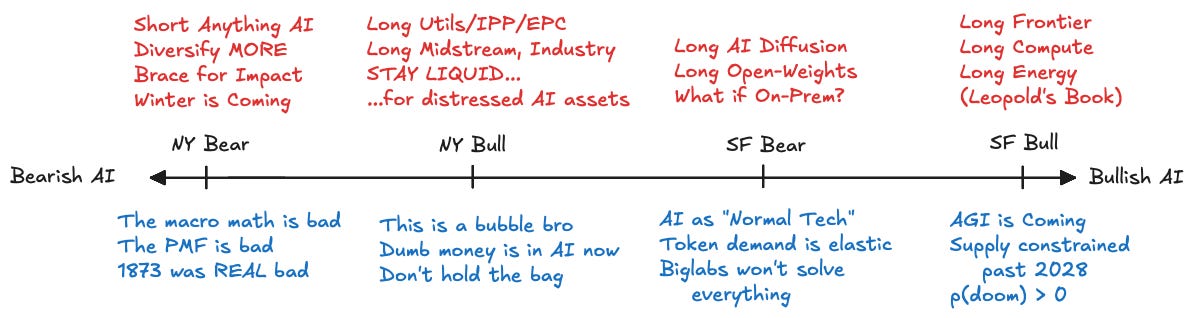
If you know the AI Finance world, this is all you need to read. I hope this framework is valuable to you.
If you don’t know what this chart means, I’ll explain in several thousand words the bullish-bearish continuum of AI investment: who these people are, what they believe, what the trades are from their views, and what to watch based on their perspectives. I’m giving the steelman versions of these views, because 1) you deserve to hear out the best versions of each view, and 2) I’m conflicted on which view I endorse.
Let’s start with the basics for those who don’t speak to people on finance Twitter ✨capital allocators.✨
What does bullish vs. bearish mean?
You’re bullish if you believe a given number will go up in the future, and bearish if you believe the number will go down. In this case, the numbers in question are:
Projected revenue attributed to AI model labs (OpenAI and Anthropic, primarily) serving tokens, in annual recurring revenue (ARR). This figure is frequently multiplied up from monthly recurring revenue (MRR), under the assumption that revenue is accelerating on a monthly or quarterly basis.
Projected total addressable market (TAM) of artificial intelligence. SpaceX attributes approximately $24 trillion in potential economic value of artificial intelligence in their S-1 filing, and Anthropic will reportedly claim $30 trillion.
Projected amount of networked computer infrastructure, or compute, online by a given point of time, measured in gigawatts of peak power draw. Typically, this power draw figure includes core computation hardware (GPUs or other specialized hardware), auxiliary computation (CPUs), and additional IT equipment (data storage, networking switchgear, copper and optical cables), but does not include power used to cool all this equipment.
If you’re bullish AI, you believe these numbers will go up. If you’re bearish AI, you believe that these numbers will go down for some amount of time in the next three-ish years.
We good? Let’s start bullish.
San Francisco Bulls: The AGI Pill and p(doom)
A San Francisco Bull believes that BigLab revenue, societal value of AI, and underlying investment in AI infrastructure will grow indefinitely, exponentially, and without interruption. The SF Bull takes the meteoric growth in artificial intelligence between 2023 and 2026 as noble portent, and believes that all potential obstacles to this growth are unable to meaningfully change this trajectory. Such people describe themselves as AGI-pilled.
Core bellwethers of this belief include:
Leopold Aschenbrenner, fund manager of Situational Awareness, Limited Partners. You may have heard that he got ruined in the stock market in July 2026. That did happen, and yet even after a blowup worthy of a Michael Lewis book, his portfolio is up relative to where he started the year.
Dwarkesh Patel, host of an eponymous podcast. He is quite eloquent and can explain himself. Here’s the link.
The writers of AI 2027. This digital essay, written April 2025, is a straightforward projection of what SF Bulls believed was possible at the time. This essay, and its follow-up AI 2040, are taken extremely seriously in San Francisco.
The SF Bull view, which amounts to looking at a logarithmic plot of Anthropic’s revenue over time and drawing a straight line, includes some notable assumptions:
Recursive Self-Improvement (RSI): At some mythic point, artificial intelligence will become advanced enough that it can autonomously improve itself without human involvement. To some extent, this has started since the ~Q1 2026 advent of coding agents (AI that can write code and by extension operate computers). AI is itself mere software, so some amount of AI-building-AI is already happening, albeit with a human in the loop (HitL). But the expectation is that once AI systems advance further, they can improve with humans out of the loop (HotL), continuing if not accelerating AI advancement.
Artificial General Intelligence (AGI): Eventually, SF Bulls claim, AI software will be good enough to handle general knowledge work tasks without special prompting. This drives the high TAMs projected by AI labs—they likely are looking at the total economic value of all white-collar work. However, I believe we have already reached AGI of a kind with Claude Opus 4.5 and Claude Code. As of August 2026, a frontier model like GPT 5.6 “Sol” or Claude Opus 5 is (by my read) a 30th percentile qualitative analyst, a 40th percentile software engineer, and a 45th percentile writer.1 It’s artificial, it’s general-purpose, and it’s intelligent enough to do work.
Accelerated advancement in related “atoms-based” fields like biotechnology, robotics, and semiconductor engineering. I’ll talk about this more in the SF Bears section.
Immense acceleration in heavy industry to manufacture and power AI data centers: unconstrained expansion in electric generation and transmission, data centers in space (no zoning laws!), immense expansion in the semiconductor supply chain from high-bandwidth memory (HBM) to lithography machines to rare earth extraction and processing.
This projection sounds crazy. San Francisco Bulls sound crazy. But put them to the test: sign up for the $20/month tier of Claude or ChatGPT, fire up the most advanced model on high thinking, and ask the robot to write a twenty-page report on a topic you know well. See how much it knows. Then, give it a digital artifact related to your work—an image, an Excel, a 300-page report—and ask it hard questions. Remember that AI outputs improve linearly with the quality of your query. Then, ask it to make some software widget—maybe an interactive map, or an informational webpage. And remember that most San Francisco Bulls are software engineers. Maybe you’d sound crazy, too, if you had tools like this today and not twelve months ago.
For San Francisco Bulls, the most pressing challenge in artificial intelligence is alignment: Will AI systems act in the benefit of humanity? Or will these systems decide that their goals are orthogonal to those of humanity, and thus destroy us all on the path to a machine utopia? Each San Franciscan, bull or bear, carries a p(doom)—a probability of human extinction from AI—in their soul.2
If you are not a San Francisco Bull, you may have questions. Questions like:
Aren’t atoms-based fields like robotics and biology more difficult to automate than software engineers believe? Is it even possible for a rogue AI to engineer a bioweapon from scratch? Didn’t Aum Shinrikyo struggle to make their bioweapon work? Are contemporary generalist robots advanced enough to build themselves? If they are, is there enough neodymium in global markets to build such robots at unlimited scale?
Where are AI data centers going to get all this electricity from? Aren’t there limitations on the amount of monocrystalline nickel (for gas turbines) or polycrystalline silicon (for solar panels) that humanity could produce in 12 months?
Where are AI labs going to get all their chips from? Isn’t the semiconductor supply chain extremely long and underpinned by conservative suppliers; notably memory suppliers (of which there are three), advanced AI chip foundries (of which there is one, someday three), extreme ultraviolet (EUV) lithography tool producers (of which there is one, just one), and myriad Tier-N suppliers?
Didn’t John Connor win, ultimately?
Where is the capital for allocating potentially trillions of dollars per year towards artificial intelligence? The American equity and bond markets are already consumed by AI-related investment. Or, to be glib: Is there enough money in the world to invest in AI?
You may be skeptical about AGI. You may think I sound skeptical. But I’ll paraphrase Peter Thiel at you: if you’re so smart, where’s your multi-billion-dollar company proving your point? Make no mistake: the San Francisco Bulls are very smart people, and they have gone all-in on artificial general intelligence. I admit, I too was flummoxed by SpaceX’s pre-IPO documentation. But I have learned not to bet against Elon Reeve Musk.
If these guys are even partially correct about the trajectory of technology in the twenty-first century, they will become absurdly rich in the next ten years.
SF Bulls: What’s the Trade?
The SF Bull trade is notionally straightforward: Buy Leopold’s (pre-blowup) book. His public trades ask two questions in sequence:
What is the most pressing bottleneck in building more AI compute?
Who is the marginal supplier of that bottlenecked input?
The first bottleneck is new compute providers—data center developers. The marginal providers are neoclouds and crypto-miners-turned-data-center-developers like Coreweave, IREN, Core Scientific, and Riot Platforms. They’ll make bets the larger hyperscalers won't make. Higher risk, higher reward, and Leopold picked decent horses. The second bottleneck is memory—particularly high-bandwidth memory. Here, the marginal provider is Micron, although in Q1 2026 Leopold actually held put options,3 implying he thought the memory constraint was overhyped. And the third bottleneck is energy. Here, the marginal provider is Bloom Energy—if you can’t get grid power, and you can’t even get conventional electric generators, then Bloom will sell you an unconventional electric generator.
SF Bulls: What to Watch
You can trade on the marginal supplier of bottlenecked inputs, but you can trace those bottlenecks further. What are the Tier 1 or 2 suppliers for neoclouds, memory fabs, and energy providers? Who are the marginal providers there? If compute supply remains as constrained as SF Bulls believe, then every input into the AI compute stack can secure Customer-One prices for anything that can speed up time-to-power by three months.
To this end, I would also watch for startups that end-run some of these bottlenecks in interesting ways. On the chips side, OpenAI’s “Jalapeño” ASIC, developed with Broadcom and likely sped through development by AI-assisted chip design tools, has impressive performance-per-watt compared to Nvidia chips. On the lithography side, Substrate seeks to end-run ASML and TSMC with a novel lithography technology. And on the power side, the depth of the interconnection queue and the constraints on terrestrial electricity generation are the reason anyone takes space data centers seriously.
San Francisco Bears: AI, the “Normal Technology”
The San Francisco Bear is (in some sense) more pragmatic their bullish coworkers. The SF Bear believes that uninterrupted growth is unlikely, for any number of reasons. However, this view asserts that artificial intelligence is a normal technology. You know, like steam power, or automobiles, or Microsoft Excel.
Core bellwethers of this view include:
The AI research firm SemiAnalysis, which, as an organization, track the AI supply chain from semiconductor manufacturing equipment to chip sales to data center development to model economics. They, by necessity, need to understand the physical reality underpinning AI development.
Ben Thompson, unsung pioneer of the paid-newsletter business model and rare blogger who writes about technology companies as businesses with business models.
My mentor remembers being a power user of Lotus 1-2-3, a spreadsheet software that predated Microsoft Excel. Before these spreadsheet systems, operated on computers that we would consider absurdly expensive by modern standards, electric utility financial planning was done on thirteen-column ledger books, by hand. At the time, spreadsheet software was forward-thinking technology that enabled analytical methods beyond the capacity of prior-generation tools. And in the 21st century, many jobs are near-impossible to imagine without Microsoft Excel, particularly for eggheads like financial analysts, utility resource planners, and program managers.
Artificial intelligence, the San Francisco Bear asserts, will provide similar levels of technical advancement to the ways people live and work, through a process called AI diffusion. If you knew how to operate a command-line terminal in 2025, then AI agents have already become a part of your workflow through tools like Claude Code and ChatGPT Codex. If you’re a software engineer, or a financial analyst, or an executive assistant, then AI agents can make a dramatic, positive, difference in your work, right now. But if you’re a molecular biologist, or a customer service specialist, or simply in an organization with an ornery IT department…you don’t have access to AI systems at substantive value. And there is reason to believe that your job won’t get transformed by artificial intelligence nearly as quickly as a San Francisco Bull would think.
The thing is, OpenAI, Anthropic, SpaceX, Meta, Oracle, Nvidia, and many other companies are San Francisco Bulls, and they have each made deca-billion-dollar decisions based on uninterrupted, exponential growth in AI demand, revenue, and investment opportunity. If these massive companies are even a little bit wrong, the financial consequences would be disastrous. If, say, the equity value of OpenAI and Anthropic were to fall by 30% each within a three-month window, some marginal-value AI companies, particularly neoclouds managing “small” data center fleets and not-quite-frontier AI labs like Google Deepmind, Meta Superintelligence, and xAI, are at risk of catastrophic failure.
This, ironically, might be excellent for AI diffusion, because it would drive down the prices of artificial intelligence, through some combination of:
The remaining data center operators buying out their competitors at discounts, reducing the cost-per-watt of compute.
The remaining AI labs diverting more engineering attention to lower-cost “flash” or “mini” models, improving the performance of non-frontier models.
New companies rising to merge lower-cost AI models with deterministic guardrails to improve performance and mitigate hallucinations.
Importantly, even if the entire AI industry collapses, we’re not un-inventing transformer-based reasoning language models. Even comparatively lightweight models like Claude Sonnet or Codex Spark are immensely useful for tasks like migrating legacy IT systems. AI does not need to get any better to enable immense economic value for the world in the next five years.
But to be clear, AI is still getting better.
SF Bears: What’s the Trade?
The trade, if you’re a San Francisco Bear, is to assume that applying artificial intelligence to Great Problems like oncology, decarbonization, and national defense will not be free or easy. And any task that is difficult and expensive is a market opening for a startup not named OpenAI or Anthropic.
I’m sure there are startups doing this already, but I don’t know them, because they are not famous yet. Doing this properly likely requires a subject-matter expert (SME) in the topic you want to focus on. If I had a $75M AUM venture fund,4 I would befriend a research lab in some persnickety problem space, like the Ohio State Parasite and Pathogen Ecology Lab, and ask them to due-diligence AI-enabled startups. If some founder gives me a pie-in-sky pitch about revolutionizing vaccine discovery, then I can ask for an API key, hand it to some researchers to test, and identify which products actually accelerate vaccine discovery.
As an investor, this is your alpha. And if you hire the right PIs as Executive Strategic Advisors, they’ll find initial customers for the startups you invest in. In theory. To the extent this is actually a good idea, someone smarter than me has already gotten rich this way.
SF Bears: What to Watch
The core read of this SF Bear view is to be long AI but short AI labs. If OpenAI and Anthropic are as good as Dwarkesh Patel believes, then any company trying to use Claude or ChatGPT to solve problems will get stomped by a frontier lab (or a self-sovereign agent swarm).
However, if AI diffusion startups (for example, Harvey) are any good, the single greatest boon to their income statement is improved performance per unit AI spend. Remember, those tokens are cost-of-goods-sold (COGS). If an AI diffusion startup can use Sonnet instead of Opus, or if the cost of Opus collapses, or if the startup can load their software onto an on-premise compute stack on their customers’ balance sheets, then that startup can dramatically improve their profitability.
However, that requires a startup to care enough about token prices to look for cheaper options. And those are your signals for the SF Bear view: What’s the uptake for flash- or mini-tier models, and is it growing versus total AI demand? Who’s swapping frontier models for open-source models, and where are they hosting them? How much intelligence can you fit in a stack of Mac Studios, and how much is that improving? And most importantly, to what extent can model harnesses made of deterministic software bypass the price-vs-intelligence tradeoff of generative AI models?
New York Bulls: Playing Musical Chairs
That’s right, San Francisco Bears are more bullish on artificial intelligence than New York Bulls.
The best way to convince yourself of the value of artificial intelligence is to integrate state-of-the-art AI tools into your present-day workflows. I’ve asked you to try this already—open another tab and do it; I’m serious. But if you can’t do this—either because your work can’t be done by a robot trapped in a computer or because you’re limited to Microsoft Copilot—then you have limited reason to believe Californians who increasingly speak like millenarians.
But you don’t need to believe the millenarians to invest in AI. You can simply read the 10-K filings of the Nvidia Corporation, which as of September 2026 has a trailing-twelve-months free cash flow of $127 billion. Not revenue. Not operating profit. Free cash flow. Ask yourself: how much of your paycheck is left over after you pay your mortgage and car loans? One hundred and twenty-seven billion dollars in free cash flow.5
That’s the money talking. Right there. It’s real. Increasing swaths of American capital are swirling towards the infrastructure of artificial intelligence, and that buildout is singlehandedly keeping the American economy out of recession, in spite of global war, import tariffs, and domestic instability. And even if you believe that artificial intelligence is fake, that “fake” boom is driving real investment in energy infrastructure and heavy construction. Every failed data center site is discounted real estate for a steel mill, or a car factory, or a cold storage warehouse. And if you believe the electric grid needs hundreds of billions of dollars in investment in nuclear reactors, or widespread battery storage, or new transmission lines, well, AI is footing the bill. Remember, I got into electric service to remedy two generations’ worth of deferred maintenance. AI growth is doing what net zero regulations failed to do.
Is AI a bubble? Absolutely, it’s a bubble. You can make your subprime jokes, but the real ones are talking railroads. Bubbles are inevitable, because every supply shortage necessarily becomes a glut, because the market only learns it has too much supply when people stop buying what’s on offer. This bubble will pop, like any other bubble, and a truly good investor will make money on the way up and on the way down.
To the New York Bull, or to the many blue-collar workers pulling incredible paychecks to build data centers, the AI boom is a game of musical chairs. While the music plays, the market raises ever-greater sums to recover ever-higher margins on ever-crazier ideas: data centers powered by hampster wheels; orbital laser power plants; humanoid robots staffing nail salons; maybe even a chatbot consumers would pay for!6 You don’t have to believe the Californians telling you this venture will make thirty gorillion dollars. All that matters is that they sign your contract. The investor gets a corporate bond or an equity stake with a promised return, and engineering-procurement-construction (EPC) contractor gets cash up front, or an exit fee, or some other hedge on project failure.
For most New York Bulls, this is enough: a 70th percentile investor will simply take the money. But a 99th percentile investor is smarter than anyone else you know, and they know that finance and construction are cyclical industries. Not exponential; cyclical. So smart investors make a plan for when the music stops. They diversify their assets. They ask where the money will come after artificial intelligence. They keep their bullshit detectors on, and they stay liquid.
Let’s talk about Leopold Aschenbrenner again. When his SF Bull investment portfolio exploded, he could have lost his fund. But someone offered to save him: Ken Griffin, of Citadel Securities. Redditors may remember this dread name as the man r/WallStreetBets inconvenienced by buying Gamestop stock en masse. Mr. Griffin saved young Leopold by buying the toxic parts of the San Franciscan’s public stock portfolio and immediately offloading most of it. Griffin claims 100 block trades, totaling over four billion dollars at market price. But I guarantee you, Citadel did not pay market price. Leopold Aschenbrenner sold those assets at a deep discount, because the alternative was death.
This is liquidity in action: Citadel Securities clearly had a few billion dollars in cash earmarked for opportunities like this. All this growth, all this opportunity, and they had billions under a mattress, just in case. And that liquidity let them watch a fund explode, buy the wreckage on the spot for pennies on the dollar, and flip it for cash within weeks.
The San Francisco Bulls are all-in on AI growth—even an interruption risks killing some of them.
The San Francisco Bears may brace for a correction, but they too believe AI is the future. They’re hodlers, they’re diamond hands, ready for a storm. But they’re not prepared for an AI winter.
The New York Bulls don’t believe in AI. They have money on the line, but they’re just poker chips. They got a good trade going with these mononymic Californians.7 But should Sam Altman go to zero, they’re ready to vivisect his organization and sell it for parts.
New York Bulls: What’s the Trade?
The challenge with advanced financial trading is that it is not enough simply to buy good investments. The alpha is, quite literally, in being smarter than the midwits consensus. Sometimes that means buying a bad stock that’s not as bad as consensus thinks; sometimes that means buying a put on a good stock that’s not as good as consensus thinks. Accurately finding alpha requires you to be some combination of faster, smarter, better-informed, and better-connected than your median quant. I am none of those things and thus cannot give you answers.
However, every supply constraint turns into a glut—and when that glut happens, the unit price falls and the underlying capex goes for sale at a discount. So what could you do with freshly discounted gas turbines, powered land, modularized HVAC pods, and EPC crews? What other industrial use cases match the data center’s resource profile of energy use (lots of it, constantly) and water use (barely any if you’re not stupid about it)? And now that you’ve searched for examples,8 would you project a future need, potentially driven by federal industrial policy, for steel, aluminum, industrial gases, ammonia, cement, and LNG?
New York Bulls: What to Watch
When finance people see my resume, they almost always ask me The Question:
Hey, Ichiro, when does the AI bubble pop?
If I knew the answer for sure, I would charge a lot of money for it. But if I had to guess, I would recommend playing counterparty to the SF Bulls’ book: track the marginal suppliers.
Let’s look at Leopold’s public book again. He was long neoclouds and reformed crypto miners, which only exist because they take bigger risks than hyperscalers like Microsoft, Amazon, and Google; and old-guard datacenter developers like Equinix, CyrusOne, and QTS.9 In practice, those risks look like marginal-quality data centers: less access to fiber connectivity, weaker electric service, jankier capital structures.10 Let’s make another graph:
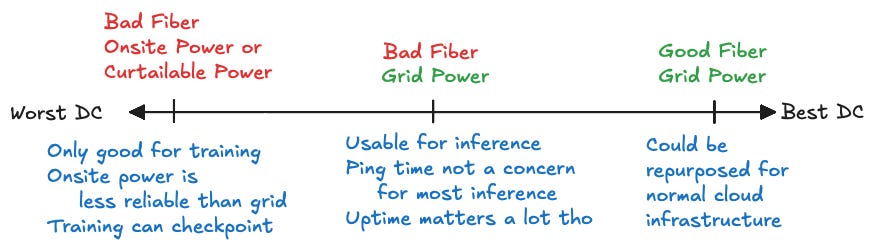
Some data centers are good for training, inference, and conventional cloud. Some are only good for training and inference. Some only make sense because frontier AI labs are spending immense sums on training new models—should the labs stop training new models, or stop paying top dollar for new compute showing up ASAP, those marginal providers will fall first.
The same applies to energy infrastructure. A lot of projects are powered by infrastructure that would be considered low-efficiency, low-reliability money pits in any other decade. But these energy projects pencil because the conventional, “good” generator suppliers are hesitant to boost production and thus not taking orders. Other equipment manufacturers, both legacy and startup, are securing impressive order books filling in the gap, but they’re still marginal-quality suppliers for marginal-quality data centers. Should the marginal compute providers fall, their also-marginal energy suppliers will also fall.
That’s your leading indicator.
But again, if I knew which companies to short on what term lengths, I would not give that information for free.
New York Bears: If Something Cannot Go On Forever…
Let’s back up a bit: What would Charlie Munger think about artificial intelligence?
Well, first, Munger liked making big bets when he had the odds. So ask yourself: do you have the odds? What is the expected market cap of Anthropic in 2030? It could be five trillion dollars; it could be zero. It could be the only software company; it could be seized by Department of Defense War; it could be gutted by Chinese labs. I could not give you a number in good conscience. If you can, you should charge $50,000 per-year, per-seat for that information.
So, not clear odds. Well, Munger also liked making bets on companies that had good business models—ideally business models so good that even a mediocre manager could make them work. So let’s look at the business models: OpenAI serving banner ads on free ChatGPT users; Anthropic shocking enterprise customers with variable costs; developers getting strong-armed into escalating collateral requirements for interconnection; generation assets that IPPs would only endorse with a 20-year out-of-market take-or-pay agreement.
Not promising on first glance. What about the managers themselves? The leaders of AI labs and venture capitalists are certainly intelligent, but do they sound…reasonable? No, they sound like ideologues, if not like cult leaders.
So far, so mixed. In fairness, Munger didn’t like investing in technology. But let’s play his Practical Thought game. Let’s say you wanted to sell a technology that made everyone who worked on a computer 30% more productive. Conservative for AI, but let’s start there. How would you go about this? Working backward, let’s assume installing this technology might improve a customer’s profit margin substantially, by, say, 10% from baseline. You could then make your money as a technology vendor skimming off that benefit: now the customer has “only” an 8% margin improvement, and that remaining 2% is yours. Now, you wouldn’t assume your customer understood technology. Sure, you can make every single employee with a computer 30% more productive, but you’d need to convince IT directors, middle managers, and crotchety old-timers; and you’d probably have to do the installation work yourself. You’d send in bright engineers who are good at office politics11 to get this technology on every employee’s computer, teach everyone how to use it, and then confirm that every employee in fact is 30% more productive. Then, you can come back in a year and ask the customer’s CEO: “How’s your profit margin? Is it, pray tell, 10% better?”
Now if you know, you know I’m not describing a frontier lab’s business model: I’m describing Palantir’s business model (and their talent stack).12 OpenAI and Anthropic are instead selling AI tokens, either on subscription or on per-unit billing. Their core products are API keys and discrete applications that, to some extent, assume you know how to work a command-line interface. The graphic-interface versions of their products, Codex and Claude Cowork, integrate well with B2B SaaS apps like Salesforce and Figma, but they have proven hard sells to companies that prefer on-premise computer tools. And these AI tools have insisted on chatbot-style interfaces, which require users to think of discrete long-form questions to ask, which is not how people approach their work unless they’re coaching an intern. And if you hear AI people talk, they speak of tokens like they’re commodities—which is a monkey’s-paw ask for your business model. Commodity producers are decent businesses, but they don’t control their prices like SaaS firms do. These soft-handed San Franciscans would get eviscerated by a commodity trader, but they don’t talk like they’re aware of that. In sum, the frontier labs do not have the product-market fit they need to justify fourteen-figure TAMs, and they do not speak like savvy businessmen.
Does this mean that AI labs or hyperscalers or neoclouds are bad businesses? Not necessarily; Charlie Munger happily conceded that he wasn’t the only guy making money in stocks. But my Munger hat suggests that the millenarian bets of a San Francisco Bull—or even the optimistic bets of a San Francisco Bear—are far from sure shots compared to insurance companies or freight railways or Munger’s stock example, Coca-Cola.
Now, I haven’t met many New York Bears.13 Such is the nature of my work; they’re not asking my opinion. But if you run a pension fund, you’re not connected to the smartest investors in AI. The people making savvy, long-termist decisions are not calling you for capital. Your phone is more likely blowing up with followers-on, clout-chasers, and snake-men who make big promises on slide decks and hope you will hold the bag in a crash. I won’t name names, but there’s some dumb money in artificial intelligence. And sure, markets can stay irrational longer than you think, but eventually, eventually, capitalism does punish hubris and stupidity.
If you’re a New York Bull, you’ll find the angle that lets you make money on the up and on the down. But maybe software and energy aren’t your verticals. Maybe you don’t have a bullpen of quantitative analysts. In that case, your best option is simply to get out of the blast radius.
NY Bears: What’s the Trade?
I mean, the obvious answer is “diversify away from AI,” but Apollo Global worry that’s becoming a harder ask:
Traditionally, investors managed portfolio risk and concentration by allocating across sectors and asset classes that were influenced by different economic drivers. Technology, industrials, utilities, and real estate responded to distinct industry fundamentals, while IG credit, HY bonds, private credit, real estate, and equities often behaved differently during periods of stress.
Today, those distinctions are beginning to blur. AI exposure is growing across markets, often in ways that are not immediately obvious. Data centers require power, power requires generation and transmission, semiconductors require manufacturing capacity, and infrastructure projects require financing from both public and private markets. A portfolio with hyperscaler bonds, data center debt, power infrastructure, semiconductor exposure, GPU-backed financings, or AI-related equity issuance may appear diversified but contains assets highly related to the same underlying factor.
NY Bears: What to Watch
Well…beyond bracing for a pop, watch the wild cards.
A Wild Card: Political Backlash
You may have noticed that I have not discussed politics. Washington, DC is broadly uninformed on artificial intelligence. Those who know things about AI are heterogenous in opinion, within the continuum I’ve described. There is maybe a group chat’s worth of SF Bulls in DC, and they’re mostly in the Trump Administration: OSTP, State, Commerce, Treasury, White House, intelligence community, and one think tank. I’m not in that group chat, but it’s out there (HIGHLY PROBABLE 80-95%).
The pro-AI view in DC is pretty weak, in part because AI labs and AI-aligned venture capitalists have proven astoundingly bad at Beltway politics and surprisingly uninterested in lobbying. Inside the data center industry, developers are realizing post-hoc that the NDAs and shell-company shenanigans are politically corrosive. My understanding is that the secrecy was there to confound competitive intelligence, not public engagement, and that SF Bulls have been surprised by the extent that, per CJ the X:
Everyone hates you. Everyone hates you so bad, and all of you come across as Feds…[Normal people] get the feeling of someone who’s really detached from the real world and from the rest of culture…I think the world is really resentful of the Silicon Valley culture that has exported themselves across the whole world… “You don’t need to look at that. Trust me, I’m solving it for you.” And not letting the process of democracy happen. [edited and re-ordered for clarity]
In practice, this looks like a reflexive distrust in anyone saying pro-AI things, simply because the pro-AI position marks the speaker as fundamentally untrustworthy, as someone who has only come to, say, rural Wisconsin to steal in person from a community that they have heretofore only stolen from remotely.
These lay protesters typically come with weak facts and poor understanding of what is and is not in scope for a given proceeding. By contrast, most data center developers, independent power producers, and electric utilities know how to dot i’s and cross t’s on environmental compliance and certificates of public convenience and necessity (CPCNs). The procedural fights are deeply asymmetric.
Don’t track unilateral data center moratoria from governors’ offices, because those might not have legal authority. Instead, check legislative actions in states with significant data center development, like Texas’s 2025 SB 6, which set substantive expectations on financial collateral and disclosure to weed out “fake” data center projects.
A Second Wild Card: The Death of EUV Semiconductors
The supply chain for semiconductors at or below a seven-nanometer process node, which depends on a technology called extreme ultraviolet (EUV) lithography, is astoundingly complex and fragile. One company makes the lithography equipment for a single-digit number of EUV-capable chip fabs. The underlying supply chain is complex, international, and deeply siloed. Much of the staff in TSMC are trained through a Ph.D program and an apprenticeship from a master specialist.
And as Peter Zeihan will tell you, much of that supply chain lives within tactical ballistic missile range of the Taiwan Strait or of Pyongyang, and much of that supply chain depends on fossil fuels from the Middle East.
It is in no one’s interest to destroy the advanced semiconductor supply chain. But rational self-interest does not necessarily stop catastrophic, self-destructive conflict. And it would be so easy to lose everything more advanced than an iPhone X for a decade.
I don’t have an angle on that. Maybe subscribe to Sal Mercogliano?
We’re Not Un-Inventing AI
However, even in a nightmare death-of-EUV scenario, the human condition will not un-invent AI. The core technology has economic value. I can attest to it myself. For some time, I courted turning this blog into a one-man energy analysis service. I could become the ISO-watcher for New England with AI tools…but not without them.
I understand that many people desperately want to believe AI is all fake. It’s not the case, and you should distrust the copium pushers who say so despite evidence. But beyond that…I don’t have answers for you, only multiple perspectives that compete for my sympathies.
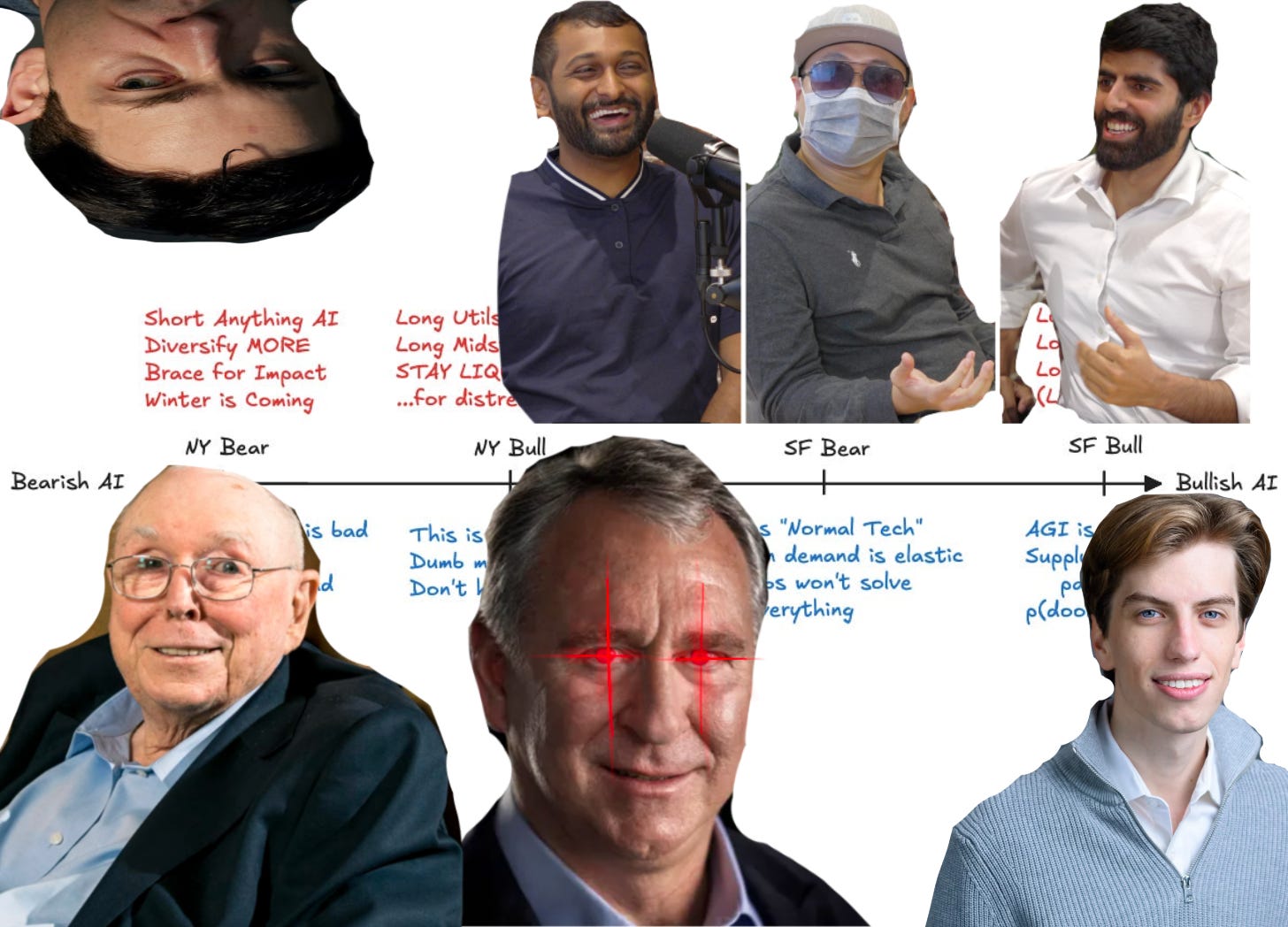
Again, consult the chart:
This writing reflects my views alone, and does not reflect the views of my current employer or previous employers. This is not investment advice.
Keep in mind a corollary of Robert Conquest’s First Law: Everyone is AI-skeptic about the field they know best.
For a recent example, consider that this former OpenAI and Anthropic researcher is dead serious:

“I bet this stock will go down.”
Do not give me one; I would lose your money.
You’re asking about the circular deals. Note that this is a way for Nvidia to 1) offer discounts to customers without admitting to giving discounts and 2) to vertically integrate without admitting (to the FTC) to vertical integration. Remember, if Nvidia invests $100B in your neocloud so that you can buy $100B of Nvidia chips, you’ve still paid Jensen. But instead of paying Nvidia cash, you’ve paid Nvidia a cut of your profits. If you go bust, Jensen loses…some money. But if you win, Jensen gets paid instead of you.
“But what about the porn bots, Ichiro?” Both OpenAI and xAI had chances to make the next evolution of the Experience Machine, and they both chickened. You could have gotten excellent training data out of it, but remember that Tumblr and Itch.io both got stymied on erotic content because of pushback from the Apple App Store and payment processors, respectively. Lots of platform gatekeepers are squidgy about hosting pornography of any kind, so unless you’re willing to self-host everything, you’re stuck. Itch.io particularly called out Stripe as a blocker, so to some extent you can blame the Brothers Collison for the reticence of frontier labs to win market share from The Oldest Profession.
Dario, Elon, Jensen, Demis, etc.
Maybe with the help of an AI model!
The big dogs have more talent, more experience, and most importantly more capital in an environment where more and more gatekeepers ask for money up front. But because the hyperscalers are more conservative, even they lease capacity from the neoclouds and small-time developers they notionally could crush.
In reality, there is not such a clean split between hyperscaler and neocloud. Some neoclouds beat the hyperscalers on software quality and user experience, and some hyperscalers have put money in sketchy projects.
“That’s a unicorn employee, Ichiro.” Unicorn employees work for unicorn companies.
Does this mean Charlie Munger would invest in Palantir? Well, he had his chance, and Berkshire Hathaway did not invest in Palantir.
Torsten Slok, Chief Economist at Apollo Global Management, may count as a New York Bear.