


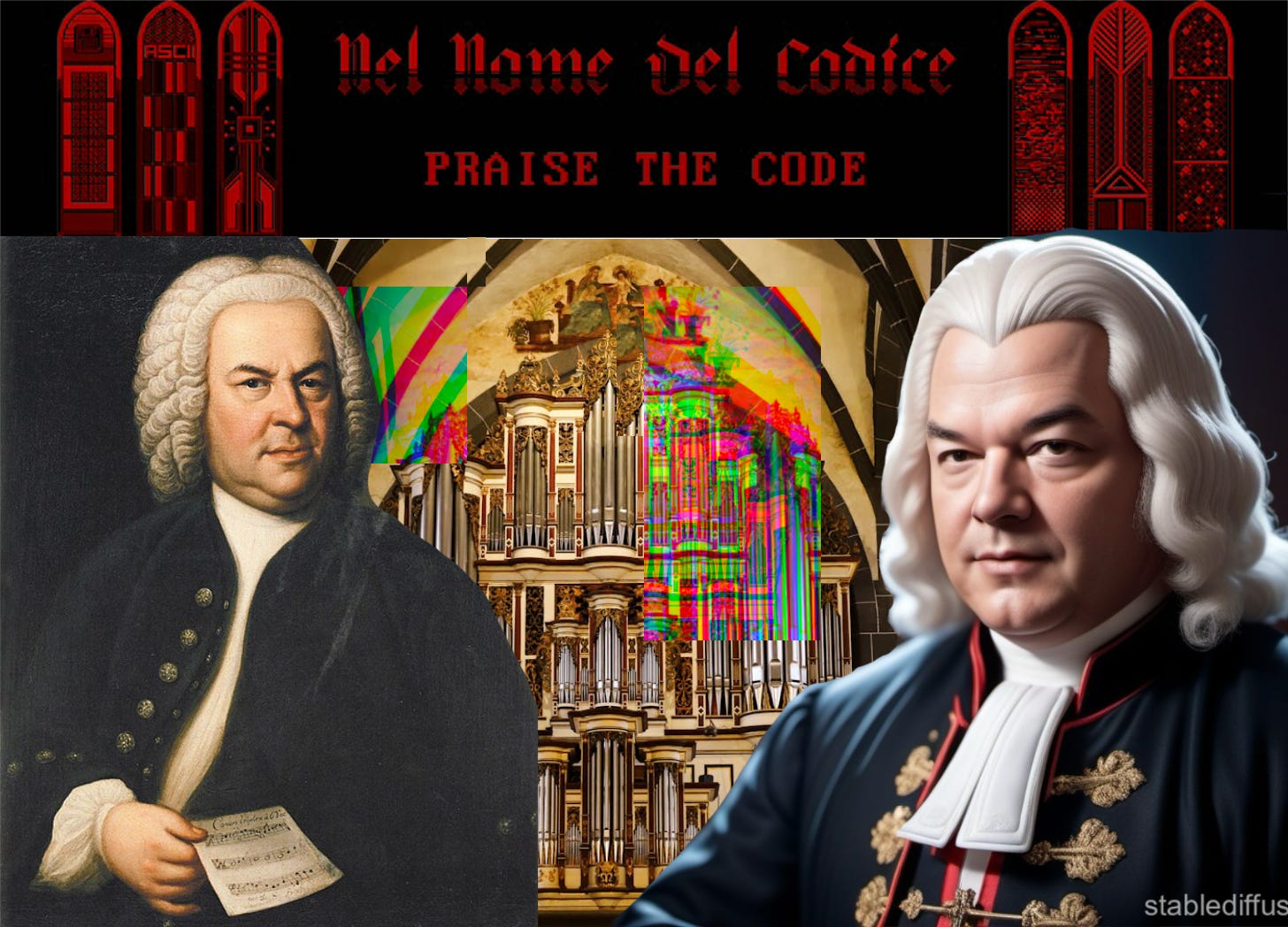
Keygen Church, in brief, rocks.
I first heard of Vittorio D’Amore’s1 music through Ultrakill, a video game kitbash of Quake’s mechanical and graphical foundation and Devil May Cry’s combo system and Dantean aesthetic, scored by a musical kitbash of industrial metal and breakcore.2 Keygen Church appears as a guest musician for a secret challenge level, battling through the rainy streets of some hypergothic city deep within Hell.
But there’s more where that came from, courtesy a trio of standalone albums. The first two albums, curiously, have gibberish names and song titles that, appropriately, look like software license keys generated to bypass digital rights management (DRM) controls. D’Amore’s music is a kitbash of its own, of Baroque liturgical music and black metal, albeit with a distinctly MIDI-driven sound palette. Particularly, Keygen Church uses stuttering frequency-modulated synthesizers instead of the 7- and 8-stringed guitars preferred by the Tosins Abasi of the metal scene. The result is obviously simulated, in a manner that evokes DOOM’s MIDI-metal soundtrack and proves Brian Eno right.
The music rocks. The vibe is immaculate. But there’s a small, incidental, potentially-lethal-in-the-2020s problem with Keygen Church: I can’t tell individual songs apart.
Music Done By The Book
When I say Keygen Church’s discography pulls influence from Baroque liturgical music, I mean Johann Sebastian Bach’s liturgical music. And by Bach, I particularly mean his minor-key organ works. And by Bach’s minor-key organ works, I particularly mean BWV 565, the Toccata and Fugue in D Minor whose opening fanfare is branded into the contemporary Gothic mythos. Many of the passages in this composition sound like they could presage a sick DOOM metal riff—in fact, one could imagine an EP of music in Keygen Church’s exact style made simply by chopping up BWV 565 (or BWV 542, or BWV 582) into sixteen-measure segments, ignoring the sections that dip into major keys for more than a measure or two, and interspersing those segments between power-chord riffs and double-kick drum patterns. It would be pretty sick.
But it would also be pretty replicable. Bach himself was incredibly prolific and specifically interested in technology towards mathematically perfect music. Consider his Well-Tempered Clavier (1722) collection (BWV 846-893), which includes a prelude and fugue in every major and minor key as a tech demo for 12-tone tuning on keyboard instruments, including harpsichords, clavichords, and new-for-the-time pianofortes. Bach, an accomplished keyboard and organ player in his own right, was a stickler for tuning, and insisted on a tuning system that sacrificed perfect tuning in any given key for acceptable tuning in every key at once. In 2026, twelve-tone even tempering (12-TET), an relative of Bach’s now-lost tuning preferences, is taken for granted, but tuning standards were not a given in the 1720s. A competing tuning system in the late Baroque era, meantone tuning, would actually sound better across “normal” key signatures, and would only break if you wanted to write a Prelude and Fugue in C# Major…which Bach did. The pieces in The Well-Tempered Clavier exist to prove the feasibility of a technical standard, in the same way the soundtrack to Super Mario Bros. (1985) proved the compositional power of the NES’s Ricoh 2A03 sound chip. Bach’s work would be musically relevant even without its chromatic party trick, but it’s public domain now. Combined, the two books are 487 KB of MIDI data—small enough to convert into text, feed into a frontier model, and prompt “Generate Bach on command.”
In fact, The Well-Tempered Clavier would be a uniquely strong basis for AI-generated music. It calls for one instrument with straightforward notation, and its theory is so perfect that it precedes a musical society that merged math and music towards a grand-watchmaker theory of God, founded by a student of Bach, Lorenz Christoph Mizler. Not only did Mizler translate a literal textbook on counterpoint music theory3 into German, he also started a Corresponding Society of the Musical Sciences and wrote his own commentaries on composers and mathematicians—because for him, the distinction between mathematics and music theory was quite thin. There is extensive writing, much of it from Germany, seeking to nail down the structure and composition of music into something exquisitely rational, indeed so rational that it serves as a call toward the Ultimate Rationality of God. Of course, artificial intelligence also calls toward such an Ultimate Rationality,4 which suggests it may work well with the writings in Mizler’s musikalische bibliothek, using that theory to replicate music so “by the book” that the books were based on the music.
The Two Turing Tests of Music
I suspect that Opus 4.7 and GPT 5.5 would struggle to build my proposed Bach Printer. These models are multi-modal, but they were not trained explicitly on music. Dedicated music models like Suno may fare better, but they seem to deal in stems (or fully-formed tracks in Lyria’s case) instead of the MIDI sequences and VST patches I recognize from my prior life as a musician. A YouTube skim confirms that attempts to write AI Bach sound…okay…if you’re Wheatley from Portal 2.5 But to my semi-trained ear, the AI dupes don’t sound quite like the original. Maybe we’ll get there by the end of 2026, but I think the limitations are in personnel more than technology: flipping through Suno AI’s YouTube channel does not give me the impression that they, uh, like music.
Keygen Church is no Bach, but I think he’s also safe for now—my initial attempt to replicate his steez with suno-5.5-preview was too sonically polished and not married enough to a specific motif to match D’Amore’s music, which his label ironically describes as “100% Synthesized. 100% Dehumanized.” And D’Amore stepped up his game in his latest album, Nel Nome Del Codice (2024). The compositions are more complex, the mix adds some tasteful reverb, and many of the tracks now feature a synthesized choir that, per the liner notes, were designed by English-language developers and manhandled into Italian lyrics. This continued insistence on artificiality—the guitars remain fake, too—ironically differentiates Keygen Church from AI-generated music in his style, because Suno insists on an Antonoff-esque gloss that D’Amore rejects out of reverence to the crunchy music packaged with software crackers, music that was crunchy because the files were small, music that was written on damn-near machine code, like Koji Kondo might have done for Super Mario Bros. Vittorio D’Amore’s vision of computer-generated music—harsh, deterministic, evoking the flaws of outmoded technology out of nostalgia—is so different from the stochastic calculation of deep neural networks that his music sounds human in a way that AI can’t copy yet.
Again, the technology can catch up. But designing AI music tools that can exactly replicate human music is actually the harder of two Turing Tests for music. The easier test is whether the AI clones are close enough that I don’t care that they’re slop copies of the true form. I might not care, because I might not be listening to the music.
Not All Music Is For Listening
Christopher Nolan movies have excellent scores: think Hans Zimmer’s brass hits in Inception (2010) and Ludwig Göranssen’s “trucks in place” sidechaining in TENET (2020). In these cases, the music is not meant to be played in isolation. Instead, they exist to complement a larger audiovisual work, to augment the imagery and push emotional responses without pulling focus. This applies even more to video game soundtracks, which must fit into an even more complicated sensory experience. The music itself is not for listening. Consider also lo-fi hip-hop streams, which exist one step above general foley as a means of drowning out both background noise and intrusive thoughts without distracting from the consumer’s work/study/chill/sleep session. Or consider Drake’s More Life (2017), which was explicitly marketed as a playlist and works quite well as background music for a house party: interesting enough to fill in awkward silences but bland enough not to pull focus from conversations.
These genres of music are eminently replaceable by AI—in fact, YouTube is now replete with multi-hour playlists of AI-generated lo-fi hip-hop…as well as playlists that proudly declare 0% AI audio in the much the same way Whole Foods proudly declares products to be organic and non-GMO. It’s a luxury label. I, personally, can recognize the handcrafted production value from musicians like xander., who was making wavy Cashmere Cat-ass tracks on SoundCloud before he churned out lo-fi beats for the live-streaming channel Lofi Girl. Shuffling through his latest album A Quiet Hour (2026) reveals a whole set of layered melody-texture-foley soundscapes that reward close attention on high-quality headphones. But the modal lo-fi hip-hop listening experience involves playing the music on laptop speakers while focusing on something besides the music. How expensive is Alexander Papamitrou’s nuanced but ultimately workmanlike audio production, versus a stack of tokens? And to what extent will a customer notice the drop in quality, should a lo-fi hip-hop stream (or more likely a playlist on a streaming service) fold in an increasing proportion of AI-generated tracks in the style of xander. beats?
This is the true risk of AI-generated music. It’s the marginal supplier of new audio, in contexts where the audio is not the main point of focus—background playlists, soundtracks, stock music. Some of this AI music will go towards projects that would have otherwise used Mr. Scruff’s “Kalimba” (2008). Some potential customers will choose against AI music for fear of audience backlash.
But someday, another video game developer will make a level taking place in the rainy streets of some hypergothic city deep within Hell. And unlike Hakita, they may not love metal and electronic music enough to respond to Vittorio D’Amore’s email.
Perhaps that developer will pay a computer to replicate the already-mechanized composition of Bach and interlace it with synthetic metal riffs, albeit with a prompt closer to epic-gothic-church-heavy-metal-video-game. It won’t sound exactly like Keygen Church, but…it’s not like I could name a favorite track of his.
This writing reflects my views alone, and does not reflect the views of my current employer or previous employers. This is not investment advice.
What a name for a musician—Victor Love!
The initial website for Ultrakill made this kitbash explicit: devilmayquake.com
Gradus ad Parnassum (1725) by Johann Joseph Fux, originally in Latin
Albeit a competing Ultimate Rationality, hence the Catholic Church’s recent involvement in AI. I suspect that in 100 years, next to the statues of slain pagan Roman gods, we may see a ruined GB200 NVL72 rack, yet another trophy of Christ the God-Slayer. See also Dan Carlin’s Twilight of the Aesir series.
This particular level has an excellent riff on Bach’s Little Prelude No. 2 in C Minor (BWV 934). The track, “Machiavellian Bach,” also explores the idea of computerizing Bach, albeit with a warbling arpeggiator instead of synthetic guitars.
I love Keiki Kobayashi’s music and the Ace Combat OSTs. There’s a joke that when you choose a two-seat fighter, Kobayashi himself is sitting in the back seat playing the BGM while you fly 😂
Then AC7 introduced a boss whose backseater is literally an AI. With that joke in mind, it adds a symbolic duel between human and AI.
Interesting take. But the main point is elsewhere. The machine should always be the instrument, never the composer. That is for the simple fact that, while AI can understand music and its canons and can replicate a statistical average version of it, machines have no purpose and are not willing to break the rules unless they are told to. To mix synthesized metal with Baroque classical music would be wrong for the tradition of each of these styles, but in Keygen Church they are merged together to create something new. The machine doesn't need to break rules or to do something different, because it has no self-consciousness or will. It doesn't have the experience, the struggle, the despair, the joy of a human being, which are what push an artist to compose in a certain way, to use one sound instead of another, one reverb or effect instead of another, one mix or EQ, one note instead of another, and so on. The machine can replicate everything but can't take any decision on its own. I think the real future of AI applied to music is instead to create increasingly advanced and customized tools, aka instruments, controlled by the creator in order to render music, which is different from generating. Generating means no control. Rendering, on the other hand (live or as a file), is the opposite, because it is a tool specifically designed to do what the creator wants. Praise The Code