


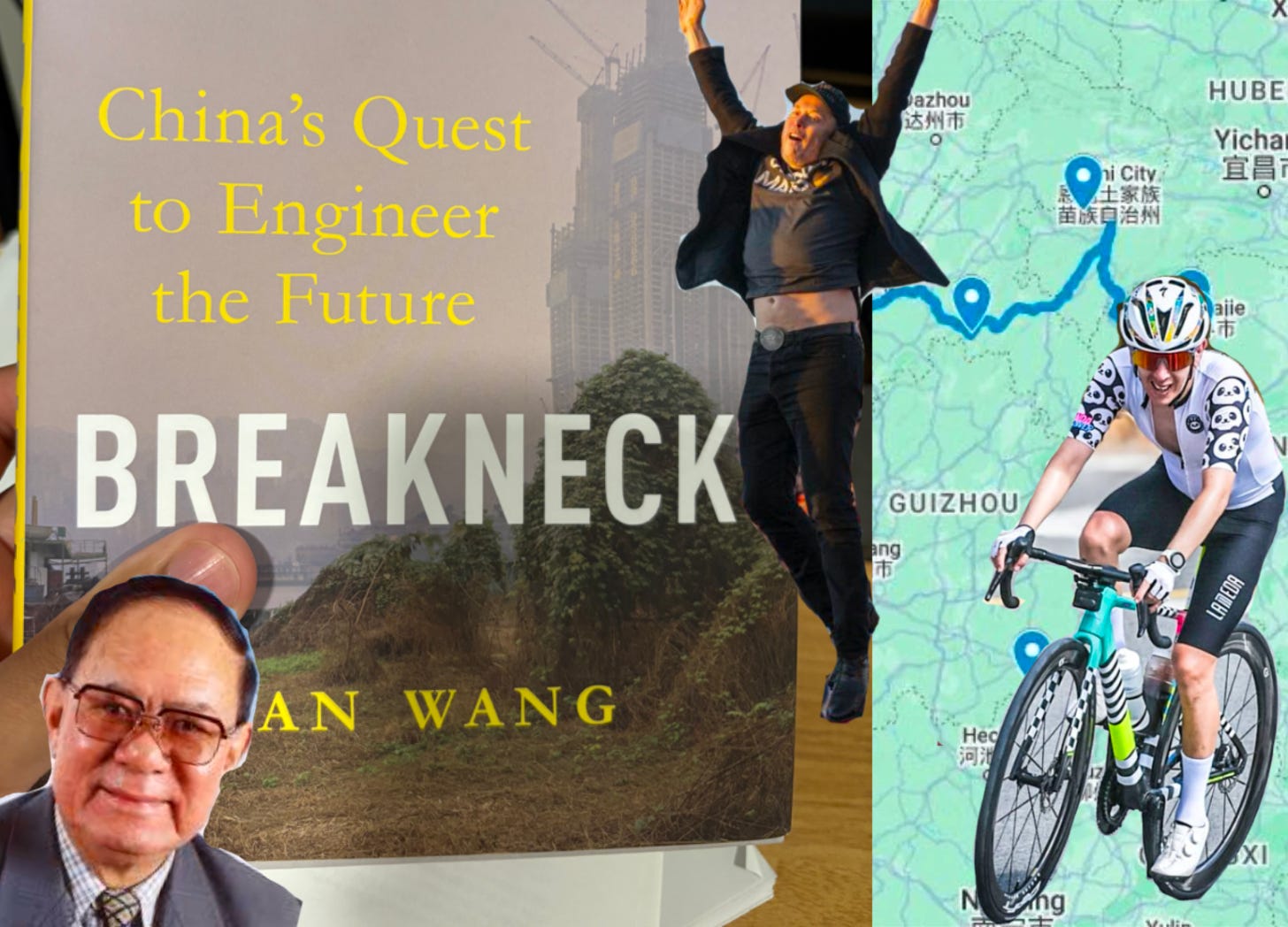
I wish Dan Wang talked more about his bike.
This is, partially, a personal request. Wang’s bike tour across Guizhou sounds awesome, and I would love to learn more about how to replicate it, although I worry I’m not physically ready for the climbs.1 But more than my personal interests, I think the Chinese bike industry is a valuable microcosm of the difference between the engineering state and the lawyerly society.
Much of the development in modern road bike technology is shaped by regulations—on one end, the racing regulations of the Union Cycliste Internationale (UCI), and on the other end, patent regulations as the Big Three component manufacturers of Shimano, SRAM, and Campagnolo jockey around each other’s designs. Western brands still dominate the market (and racing pelotons), but their products are increasingly expensive, inaccessible, and…manufactured in China.
Particularly, in Xiamen. And in the throes of COVID, many of those Xiamen upstarts chose to expand from manufacturing Western products to building their own, typically selling them on AliExpress. These brands have increasingly filtered into Western consciousness through YouTube channels like Trace Velo, China Cycling, Hambini, and to a growing extent David Arthur and Francis Cade. These Chinese brands—Elves, Yoeleo, Elitewheels, 9Velo, L-TWOO, Sensah—have developed reputations for meeting the performance of Western bike components, typically at a fraction of the price.2 However, that reputation has also included spotty customer service, odd jank in final finishing and reliability, websites and naming structures that feel unmoored from customer experiences, and a looming specter of catastrophic failure because do you really think these products are safe?
Now, if you know what you’re looking for, you can find products that are not only safe, but even better at quality control than Western brands. And trust in some of these brands is growing, in part because some of them are chasing lawyerly acceptance—approval with the UCI.
The Lawyer and the Engineer
Wang’s core premise in Breakneck is nice and memeable: China is an engineering state, and the United States is a lawyerly society. Now, Wang isn’t the first person to make this observation—Wang Huning describes the United States as a “regulatory society” in America Against America (1991)—but the differentiation between engineering and law allows us readers to bypass unhelpful conversations about capitalism vs. communism and East vs. West.
Xi Jinping’s ChemE degree from Tsinghua is the cheap line. I’m more interested Song Jian 宋健. Song’s “main” job was ballistic missile guidance, for which he was more or less the best in China. His work on feedback control systems was world-renowned, and it was the second most impactful thing he did in China. See, Song was a rationalist before all of you chumps were. He got really into cybernetics in ‘50s Moscow, asking, among other things, what would happen if you applied the same principles of feedback control to an entire nation. To this end, Song was talking existential risk in the ‘70s, although his driver of p(doom) was population growth beyond the ecological carrying capacity of China—”too many people” 人口过多. Song’s solution was to reduce births through government action: the One-Child Policy. Why one child? Because that was easier to track—it turned maternity into true/false boolean.
Dan Wang stresses that Song’s “calculations” were bunk—Song assumed linear population growth and fixed productivity on arable land, in part because he really did believe you could model a nation on a spreadsheet. Now, I know you know that the One-Child Policy was misguided, and that it had pernicious unforeseen (to the Politburo) consequences. But Wang takes pains to clarify how brutal it was for the women—specifically the women—who lived through it.
Wang argues that only Communist China, only an engineering state, would even begin to give a dude like Song Jian influence over policy, but…Elon Musk had real political sway in Washington for a few months. The software engineers of Silicon Valley are ascendant in the government. Many in the rising tech right speak of total fertility rate (TFR), measured in the engineer-brained unit of births per woman, an incredibly cold unit that reduces women to mothers, mothers to wombs, and wombs to a macroeconomic denominator. Wang’s chapter on the One Child policy convinced me that any discussion about birth rates is dangerously incomplete without folding women at scale into the conversation. (It isn’t happening right now.) At “best” we get Chinese women’s response to the new Three-Child policy: *maybe if the birth rate hits zero, they’ll do something about the spy cameras in changing rooms.* At worst, we muscle into a “pro-birth” policy as brutal as One-Child.
As I slog through compliance paperwork on Excel sheets with broken macros, I find sympathy toward bringing engineer-brained approaches to American governance. It would be nice for the United States to embrace quick-and-dirty, brute-force, 5%-error-is-fine, fail-fast, ship-it-now policy. My most cruel fantasies involve baseball bats introduced to the knees standing against new infrastructure. But we proponents of state capacity must mind the risk of overcorrection. Guardrails remain important, despite their current overreach.
We must refrain from concluding that Song Jian was based.
The State and the Society
While living in China, Dan Wang particularly missed the books. He apparently could not buy physical books in China—instead, he asked people to send him forty-pound boxes of books from overseas, without a clear sense of what would and would not be confiscated by customs on the way over. This seems to be, in part, because the bookstores that a man of letters would want have already been chased out of China. Wang particularly names Nowhere Books 飛地書店, a Chinese-language bookstore with locations in Taipei and (at least for a time) Chiang Mai—but not in China. There are others—One-Way Space 单向空间 has kept a foothold in Beijing, but they’ve expanded into Tokyo as…insurance. And if you want good Chinese-language comedy, it has fled to New York now. Nicholas Welch describes these émigrés as minjian 民間 intellectuals. Grassroots. Wang hangs on a more popular term: to rùn 润.
There are, of course, options for where to rùn. If you can get an Anglophone visa, you do. If you want to build a startup but get maybe ninety days’ notice before Beijing bonks your company, you go to Singapore.3 If you have money (and taste), you go to Japan. And if you just want to chill, you go to Chiang Mai, deep in the Zomian highlands that James C. Scott described as a laboratory of social measures for defying state control. But if you’re dissatisfied with the grind of working 996 hours (actually it’s 007 now) and burning your salary on rent and fandom trinkets, or if you’re trying to hold to a serious moral code that isn’t Xi Jinping thought, you have decreasing leeway for living a life on your own terms in China. If you want to build a “parallel polis”, per Václav Benda, you increasingly must do so outside the reach of the Chinese government.4 Or at least, that’s how it looks on my side of the screen.
Wang’s Sino-American distinction isn’t merely between engineers and lawyers; it’s between state and society. Are artists and writers and booksellers merely broke, or are they persecuted? Are political agitators opposition or dissidents? How much of your life can you live without thinking about the government?
I, of course, can’t relate to the Chinese experience here. I live in New England, which is sooner sliding into cultural irrelevance than transforming to reflect the rising Trump coalition. But that might change, because the tech right people I follow are down on culture and interested in crushing it. The art is woke, they say. The music is too gay. We must RETVRN to AI-generated riffs on Florentine Renaissance painting, or else build atop the graphic design of Neon Genesis Evangelion and Call of Duty 4: Modern Warfare. We must reject the museum curators and English professors and critical theorists whole cloth, shove them into lockers where they belong, and replace them with…uh….
This frustrates me, because I’m an artist, not just a utility analyst. I’ve made my own literary fiction, photography, and electronic music, and I’m genuinely enthralled by the work of artists like Cy Twombly5 and Marcel Duchamp.
And…I gotta be real with you, many of the tech right and abundance left people I’m in political coalition with have no art taste. Jonathan Keeperman insists to me that art is right-wing iff it’s good, but where are the art boys in the Trump world? Why do the intellectuals in this space reach for flat emulations of Greco-Roman design, or AI-generated kitsch and flash, when the Italian Futurists dropped so much heat? What music has come out of Dimes Square? What’s the typeface of the New Right? I could tell you about ARX-Han and the U.S. Graphics Company and that Amen Break in an Anduril promo video, but I am deeply concerned that the people proposing a return to engineering in the United States almost universally have wack taste in art.
It’s all state capacity, and no societal development.
And that society is important, largely because a state is too mechanized to be fully flexible, but too human-operated and fundamentally janky to be fully predictable. There needs to be distance between the state and one’s life, no matter how competent that state may be. Remember, the Chinese government is our model for effective operational governance, and it still promoted the architect of Shanghai’s generationally traumatic lockdowns to premier.
How Much Engineering State Do We Really Want?
I didn’t read about China in this book about China—I read about the United States. And that’s on me. To a decent extent, I already knew about Beijing’s capacity to run operationally effective governance. I’m already Deng-pilled. I’m already in coalition with the people who seek to transform the United States into an engineering state again.
But I didn’t know about the utter brutality of the One Child Policy, or about the absolute chaos possible when a state as immense as China’s acts without a plan. I’ve been thinking about rùn since Wang wrote about it in his 2023 letter. But now I will also think about Song Jian: the original state cybernetician, the ur-rationalist, the first guy to build a digital twin of a nation and suggest policy from those calculations. Elon wishes.
I’ll keep referencing this book. I’m sad Wang couldn’t stuff the back third with his opinions on opera again. I would love to join a bike trip through China. I worry that—even if I improve my watts, even if I figure out WeChat, even if I go there with a friend who knows what’s up—the writing on this blog will cause me problems at the border.
In the meantime, I live around some excellent cycling routes. If Wang is interested, I have an excellent 40-mile loop that hits a country store and a brewery.
This post and the information presented are intended for informational purposes only. The views expressed herein are the author’s alone and do not reflect those of their current or previous employers or any elected officials. The author makes no recommendations toward any electric utility, regulatory body, or other organization. While certain information contained herein has been obtained from sources believed to be reliable, the author has not independently verified this information, and its accuracy and completeness cannot be guaranteed. Accordingly, no representation or warranty, express or implied, is made as to, and no reliance should be placed on, the fairness, accuracy, timeliness or completeness of this information. The author assumes no liability for this information and no obligation to update the information or analysis contained herein in the future.
For details: I have a lightweight steel bike with a 50/34 chainring, an 11-30 ten-speed cassette, rim brakes, and 28c tires. The bike was built for crit racing, but I am built fat and slow. Please advise.
That Wang apparently chose a Giant TCR instead of all these options says…something about him. Probably “he just wants his bike to work.”
Alternately, if you want to work on AI without getting squeezed by a Washington throttling NVIDIA chips or a Beijing that kinda thinks software companies are fake, you go to Singapore.
At the very least, China still has amazing music, as relayed by Concrete Avalanche. Apparently Bandcamp and Apple Music still reach through the Firewall. But I worry the musicians don’t have too long, either.
I unironically have this framed in my apartment.
Excited to read this book over the long weekend. Thank you for a great review!
Its definitely on my reading list. China and America's future are intertwined regardless of either countries politics.
Dan Wang will be speaking here in SF, and it will be streamed:
https://www.commonwealthclub.org/events/2025-09-29/dan-wang-chinas-quest-engineer-future
Also, Dwarkesh has had several recent podcasts on China that have been very interesting.