


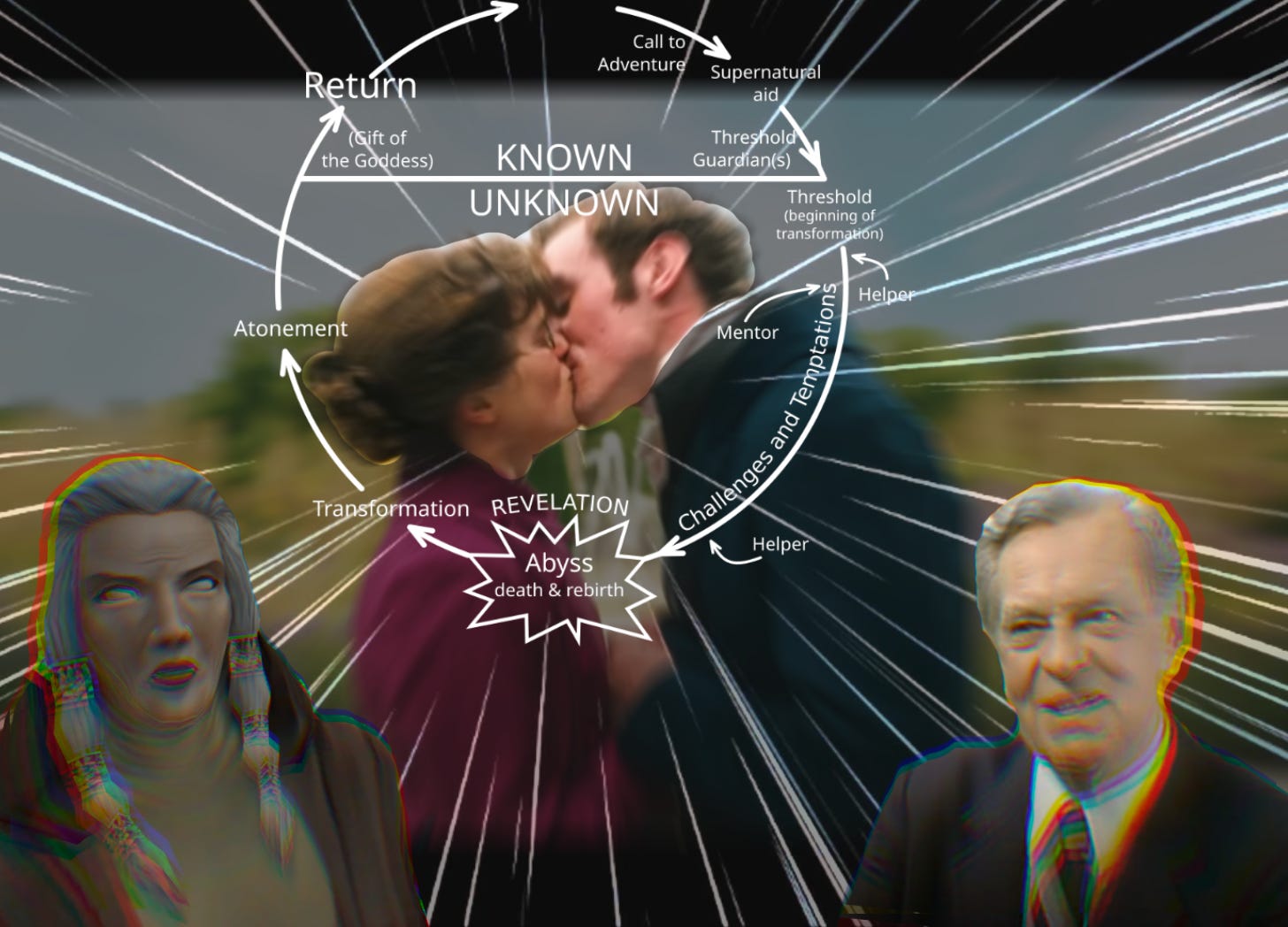
The 2026 TV adaptation of The Other Bennet Sister dressed early-season Mary Bennett in bangs and ruffed lace collars, styles that were out-of-fashion and frumpy for the Regency era. Additionally, her dresses at home were ill-fitting, appropriate for a middle child wearing hand-me-down clothes. Per my friend who proudly touts his pedantry on accuracy in period dramas, the show meets his approval (albeit with some notes).1 Janice Hadlow’s 2020 original novel, meanwhile, manages prose that imitates Austen’s sentence structure and penchant for short chapters, albeit with less dry English wit. The story, in both forms, minds the historical details.
And within this careful read of period fashions and connotations, we must consider the dire social scandal of Mary Hayward née Bennet’s fate. The Bennets are—were—downwardly mobile, but the family is landed gentry. In traditional Georgian logic, they’re higher in standing than the new-money Bingleys. It’s only because of the strange new world of industrialization, global trade, and revolutionary egalité that the Bingleys are relevant. Charles Bingley does not own land at the start of Pride and Prejudice (1813)—his wide-eyed fascination with Netherfield Park comes in part from never considering he’d get this far. And his sister Caroline’s stuffy attitude (and desperate come-ons to Darcy) come in part from knowing that her stature in polite society is tenuous.
Thomas Hayward, by contrast, does not have a fortune borne of trade, nor even a military office. He is—quite literally—a middling-class man, a working man. Mary’s marriage to this fellow is—by Old Logic—an even greater fall in station than Lydia’s marriage to Mr. Wickham, and without any financial upside. No land, no servants, not even the modest spending money that her father could provide.
Mary Hayward falls in love on accident, only after giving up on love, and that love comes at a dire cost to the remnants of her social standing. Her romance stammers and fumbles through London society, a story of a Meryton Four finding the hand of a shy nerd who knows how little he has to offer.
Joseph Campbell would be disappointed.
The Heroine’s Journey
If Janice Hadlow (and by extension Sarah Quintrell and Maddie Dai) wanted this story to pop, she could have stuck to the rom-com script. There are books on this now, like Billy Mernit’s Writing the Romantic Comedy (2020 ed.). And…well, there’s always Jane Austen’s Pride and Prejudice.
Mernit builds the romantic comedy2 on a three-act structure:
The Meet: Boy meets girl, the chemistry is established, the conflict is set up.
The Lose: The conflict pays off, boy and girl are separated.
The Get: Boy and girl find each other again, drama ensues, roll credits on the kiss.
Pride and Prejudice is, of course, among the best examples of this structure. Lizzy and Darcy meet first at the Meryton Assembly. They meet again when Lizzy stomps into Darcy’s life, chirps him on his high standards of women, and tracks mud over his heart as the one woman who can meet him barb-for-barb. Darcy loses Lizzy by overplaying his hand at Hunsford. His irrepressible feelings contradict his repeated poor impressions upon Lizzy and invite fury so eloquent that the BBC could only abridge it for their 1995 TV adaptation. And finally, Darcy gets Lizzy’s love back in parts—first by the picture of his home, then by his respectful demeanor to her aunt and uncle, and ultimately by saving Lydia’s honor without anyone really asking him to.
Austen nails the structure: the twin Mr. Wrongs in impudent Mr. Collins and rakish Mr. Wickham, the envious Miss Wrong in Caroline Bingley, the narrative economy of having the B-plot (Jane and Bingley) and C-plot (Lydia and Wickham) be additional rom-coms that intertwine with the A-plot. Two hundred years on, these characters are bog-standard tropes, but Pride and Prejudice still holds up on the quality of the characterization. Lizzy in particular is a joy to witness, with intelligence lesser writers fail to emulate and a mean streak that separates her from blank-slate self-inserts like Bella Swan.
Taken in concert, Austen’s story functions not only as an engaging narrative, not only as a vivid picture of Regency society, but also as a model for how a woman can find love, as a checklist of symbols and obstacles to love, as an aspiration for what is possible if the reader holds faith in love.
Pride in Prejudice (1813), like Cinderella (1950), like Beauty and the Beast (1991), is a mythic story, a Heroine’s Journey, a story that crystallizes images and emotions embedded in our collective unconscious, in your brainstem: the Spark, the Rake, the One, the Happily-Ever-After.
Joseph Campbell and Mythic Stories
To expound on this Heroine’s Journey, we must speak of Jung. It’s too late to back out now.
An archetype is an idea etched into your neurological hardware. In much the same way a cat instinctively knows how to walk and hunt and insist on attention, a human is born with instincts and cognitive patterns that are largely common to the species: the concept of mother and father, the instinct to pray and idolize, the fear of the dark and of death.3 These archetypes are unconscious but universal, and thus they can be depicted and reckoned with as a collective, via symbols distilled through mythology.
The point of a myth, per Joseph Campbell’s The Hero with a Thousand Faces (1949) is to organize the semi-structured human unconscious into pictures that you and your community can visualize and face. This is why mythic stories are simple yet mutable, unrealistic yet relatable, eternal yet constantly re-told. Campbell speaks of Arjuna, Jesus, the Buddha, the Minotaur, but you more likely recognize Star Wars (1977-1983), which followed Joseph Campbell’s mythic model so effectively that its symbolism crystallizes the ethos of liberal internationalism. Even now, the pejorative term for AI—“clankers”—is lifted from a Star Wars TV show.
Campbell, writing in a 1949 we would now consider remarkably faith-based and communitarian, worried that Western society was atomizing and losing spiritual coherence, and he argued that re-sanctifying mythology would help heal a world ravaged by global conflict. He believed we needed not only tragedy, but also “comedy [stories with happy endings], the wild and careless, [the] inexhaustible joy of life invincible.” He wanted a return to stories that speak to our dreams and give structure to our personal psyches, stories that give names and images to our human experience, stories of personal labyrinths and Herculean feats, of forty years in the desert and good Samaritans, of a Star Destroyer in the sky and a lone Jedi in the forest below.
Pride and Prejudice also serves this mythic function. The story fares well to adaptation: to TV in 1995, to a movie in 2005, to a Bollywood riff in 2004. And its story serves as a rich mine of symbolism, from The Hand Twitch in the 2005 movie adaption to the broad strokes of the characters. This story—really, any romantic comedy with this structure—gives shape to the inchoate emotion and experience of courtship and matrimony. After reading Pride and Prejudice, or watching Beauty and the Beast or re-watching Cinderella, love is supposed to make more sense. That’s what love feels like; that’s what he looks like.
When my girlfriend calls me her Mr. Darcy, the great myth shines a beam into my soul, such that even my most base animal brain knows how much she loves me. It matters not that I have little in common with then-contemporary romantic deuteragonist Fitzwilliam Darcy. The symbol is what matters. And the symbol only matters because it condenses an emotion so primordial as to be inarticulable without its invocation.
Mids Deserve Love Too
Like any good myth, Pride and Prejudice has auxiliary ahadith أحاديث, in this case provided by Austen herself and preserved in memoir. Within this canon, Mary’s ultimate fate in The Other Bennet Sister, marriage to a law clerk, is Lore Accurate. Yes, Jane Austen depicted Mary as a parody. In Pride and Prejudice, she is a walking conduct book parroting out-of-context bromides from books like James Fordyce’s Sermons to Young Women (1766), which Mr. Collins pulls from Mr. Bennet’s library upon his initial visit. But Austen cared enough about poor Mary to insist in private company that mids deserve love too.
Janice Hadlow’s primary twist in The Other Bennet Sister is to declare Mary’s priggish affect intentional. Early on, Hadlow proclaims, Mary realizes she has nothing going for her—a plain face, a clumsy tongue, a mechanistic style on the piano that cannot outshine Lizzy’s vim. But she has access to her father’s library, and upon embarrassing herself at the Meryton Assembly, she determines to forsake emotion in favor of cold rationality. Fordyce, presumably, knows better than her heart. And should the text be available, perhaps Wollstonecraft would offer guidance just as steady.
The problem, however, is that Elizabeth Bennet already acts in accordance to Mary Wollstonecraft’s exhortations toward excellence, independence of mind, and active sensibility. As Vivian Jones notes in her 1996 introduction to my copy of Pride and Prejudice, Lizzy girlbosses with such swagger and alacrity that she bags an Archetypal Hottie—tall, competent, aloof, and rich. It’s Lizzy’s fate to synthesize feminist and conservative, by achieving a standard Heroine’s Journey with modern intelligence. Mary’s fate, instead, is to sink into depression upon the death of her father, as she loses even the aspirations of regard from people who could have spoken to her with kindness.
Her first true love interest, the aforementioned Thomas Hayward, does not show up until more than halfway through the story, and only after Mary makes her first meaningful step towards abandoning her self-loathing. Hayward is described as “not particularly handsome, but…so affable and amused that by the time this fact was noticed, it was too late for it to matter.” Faint praise for a Mr. Right. Mary and Hayward almost immediately banter their way into intimate conversations about William Wordsworth and emotional intensity, but Mary does not admit love to herself until three-quarters into the book nor admit love to anyone else until the penultimate chapters—first to Caroline Bingley (she’s back), then to Hayward directly.
Meanwhile, William Ryder proves an awkward candidate for Mr. Wrong, as a golden retriever boyfriend who remains a fond friend to Hayward even as they pursue the same woman. Ryder is consistently warm and funny, a himbo with wisdom where it counts, a suitor who does no wrong to Mary. When he proposes, he does so on her terms: he doesn’t mention his money, nor the sudden increase in his fortune. Instead, he insists that Mary would be a good influence on him. He promises that Mary can fix him. Yet Ryder takes Mary’s rejection in stride—no soliloquy, no desperate declarations in the rain, merely a polite letter. Mature, but not romantic. And only then does leading man Hayward return after weeks without contact.
In the TV adaptation, Hayward justifies his post-climax absence by saying he had “read between the lines.” Ryder is the pretty one, the rich one, the one who asks first, the one most women would prefer. Hayward knows where he fits in the rom-com template, and he chooses to take the L. But Mary retorts that “there were no lines,” no script to follow. Mary’s line tests the fourth wall, pointing out that the story of the most middling Bennet sister does not follow the tried-and-tested three-act format.
Instead, The Other Bennet Sister is an anti-archetypal story, a story Joseph Campbell would describe as “devoted, in great measure, to a courageous, open-eyed observation of the sickeningly broken figurations that abound before us, around us, and within…[With] no make-believe about heaven, future bliss, and compensation to alleviate the bitter majesty.” The story is messy, appropriate for the tale of a Meryton Four and a London Dweeb finding their respective looksmatches and mutually concluding that this is the best they could manage.
Mary’s turning point does not involve a glow-up. Yes, she buys nicer clothes, but she never becomes a beauty, nor does she suddenly develop a socialite’s wit. Instead, she slowly internalizes an Aristotelian principle: “Happiness depends upon ourselves ἡ εὐδαιμονία ἐφ’ ἡμῖν ἐστιν.” One cannot choose their circumstances nor their gifts, but they can choose to face the world with equanimity instead of self-loathing. And in seeking self-flourishing independent of others’ opinions, it becomes easier to love and be loved. Hayward is no Prince Charming, no Mr. Darcy. But he sees Mary’s soul, and he understands not only who Mary is but also who she could be. Ryder, sweetheart as he is, cannot keep up with Mary—and he knows it. He never had a chance.
Knights of the Old Republic 2 and The Problematizing Sequel
The Other Bennet Sister, as a sequel, seeks to problematize its progenitor work, to drag a mythic story down to earth with nuance befitting a “realistic” account. Mr. Darcy returns to proud indifference, suggesting that he has only opened up to one person.4 Mr. Collins is allowed enthusiasm and depth, as he indulges in the joy of a fellow scholar as a guest. Caroline Bingley chirps Jane and Lizzy for reeling in gorgeous men and acting surprised by their fortune—she doesn’t believe Jane Austen’s account of events. Not only does Janice Hadlow’s sequel prioritize the wounded and unfortunate, it also suggests that the noble story of old may not have been so simple.
I’ve seen this move before, in the computer role-playing game Star Wars: Knights of the Old Republic 2 (2004)—KOTOR 2, hereafter.5 The original Star Wars: Knights of the Old Republic (2003) was, as Noah Caldwell-Gervais described it, a classical implementation of Joseph Campbell’s Hero’s Journey. There’s the path from novice to master, the dichotomy of light and dark, the grand war decided by a lone hero, the Wookiee for flavor. If anything, player-character Revan’s Light Side path from amnesiac to savior of the Republic is a more powerful implementation than Luke Skywalker’s story, in part because the game allows a Dark Side path of a reborn Darth Revan. Because of the choice to choose darkness, the path of light is given more weight.
KOTOR 2 seeks to destroy that myth from the foundation. First, the world: the galaxy is shown in ruins after the events of KOTOR 1—abandoned academies, refugees everywhere, a risk that (whether Revan sought light or darkness) the Republic will collapse. Second, the protagonist: the Exile of KOTOR 2 is a wounded creature, a former general who personally pushed the button on a planet-killing weapon, and was so wounded by the blast that they lost connection to the Force. The Exile lacks the capacity or inclination to save the galaxy—saving oneself is clearly challenge enough. And third, the villain: Kreia accompanies the player-character from start to finish and explains her motives throughout the game. She says she wants to destroy the Force, and in doing so to end destiny itself. To Kreia, the clarity of light and dark in the galaxy, the grand conflicts of Jedi and Sith, are in fact bloody shackles on the free will of every organism in the galaxy. Kreia’s ideology—free will above all—shapes her lessons to the Exile. Make your choices. Face the consequences, as they ripple through the galaxy. But you must choose, because apathy is death.
From this perspective, Kreia seeks not merely to kill the Force, but to kill heroism itself. The very shape of mythology dooms people as much as it redeems them. If you’re blessed to draw the sword from the stone, Destiny will elide the consequences of your power from the holy record. But those consequences remain, discharged on the commoners carrying spears beside you. And besides, the sword in the stone was never for normal people, anyway.
Both KOTOR games operate off Dungeons & Dragons rules, but KOTOR 2 takes those mechanics seriously. By level 20, the Exile is a demonic figure capable of single-handedly destroying armies. Even with maximum Light Side alignment, the Exile carves a bloody path through the galaxy, growing stronger with each murder. The remaining Jedi in the galaxy, meeting the Exile in the ruins of a Jedi academy, describe the protagonist as a threat to existence itself. The Jedi elders call the Exile a “wound in the Force,” an outlier carrying immense power without the mythic license to do so. And because the Exile is no hero, the consequences of their actions stick to their skin. The protagonist must shoulder the responsibility for dooming Telos, destabilizing Nar Shaddaa, and instigating war on Onderon. The victories in KOTOR 2 are imperfect—it’s unclear whether the Exile’s presence actually helps anyone.
Yet to walk the light-side path in KOTOR 2 is to try to do the right thing anyway. Every deed has a price, and sometimes it’s paid by your party members. The Exile chooses to help anyway, because apathy is death. But say the Exile, upon seeing the carnage their mere presence causes, concludes that helping other people isn’t worth the effort. If they are to kill hundreds of people, then why not take the spoils for themself? Why not indulge in revenge like Sion, or resentment like Atris, or gluttony like Nihilus? On such a path, the Exile kills all the Jedi left in the galaxy, leaving Kreia to deliver a final lesson in that same ruined academy: what good is power if you learn nothing, build nothing, and find no peace? All those bodies, all those experience points, and what did you do with them? Without a choice, without an end, there is only killing until nothing is left to kill.
KOTOR 2, in problematizing KOTOR 1, seeks to challenge myth as an idea. A mythic hero is insulated from the consequences of their actions. You wouldn’t want to be near such a hero, because you would bear their karma, to lethal ends. And a mythic villain is hollow, even pitiable. The evil are not happy people. In the real world, there are simply messy choices, and the people you are accountable to.
The Other Bennet Sister wages a similar campaign, but against romance instead of heroism. Elizabeth Darcy had the easy choice—a confident, intelligent, attentive man of immense fortune. As a mythic story, this makes sense, because Darcy is the archetypal Mr. Right. But in a modern mode, Caroline Bingley is right to be suspicious of Lizzy. Among the sickeningly broken figurations of sexual marketplace value and intrasexual competition, it’s real convenient that Lizzy is authentically attracted to one of the richest men in England. We wouldn’t buy that story in a modern context—sure, you married the aloof billionaire because you alone found his secret heart of gold. Don’t insult my intelligence; you married him because you wanted his house.
Mary Bennet, by contrast, does pay a price in accepting Tom Hayward’s hand. Keep the story in period context: a contemporary Tom Hayward saw Christopher Rufo’s tweet about how well Panda Express paid and took the advice.6 He’s on the come-up, but he has no clout, his work interferes with his courtship, and he will never get rich. SheraSeven would have much to say on him, and in her absence, Mary’s Instagram comments would carry the torch. By contrast, Ryder is a stunningly rich golden-retriever boyfriend who is volunteering to be fixed. This is the man TikTok asks for. And Mary instead chooses the man who speaks to her soul, because happiness depends on herself—not other people’s opinions of her prospects.
Closure is for Heroic Fantasies
I read The Other Bennet Sister hoping for a “moral” to the story. I recognize myself in Mary, in how I only fell in love after giving up on the prospect, but I see myself more in Thomas Hayward. I spent four and a half years on the dating grind—on the apps of course, but I also sought to become both hot in public and marriageable by reputation. It was difficult, painful work, made more painful because my self-esteem was at stake, actually. I conducted extensive research (including dating content targeted at women) and concluded, much like Hayward did, that I was only eligible for love (and sympathy, and comfort, and affection) insofar as I could pay for it, in money, in appearance, in the glamor of attention from someone important.7 I found love eventually, rendering my research moot, but the wounds remain. I had hoped that others would read the book (or watch the show) and conclude that “mids deserve love” applies to mid men, too. It would have offered closure.
I found no such closure. Many viewers latched on to Mary as a vindicated character—finally, an awkward woman who doesn’t need a glow-up to find love. However, Dónal Finn is too dreamy to come off as a casualty of the chopped man epidemic.
But it was my mistake to seek closure. Real life rarely offers closure—that’s why fairy tales end with happily-ever-afters. Per Joseph Campbell, “the happy ending of the fairy tale, the myth, and the divine comedy of the soul is to be read…as a transcendence of the universal tragedy of man.” Myths offer closure, the redemption of one’s trials and tragedies, as part of the compensation package for archetypal heroism. Closure is a power fantasy! Lizzy Bennet not only gets the Billionaire Husband, but she also gets to see Jane happily married, and Lydia saved from disgrace, and Lady de Bourgh put in her place, and Caroline Bingley admitting defeat. It’s all worth it because of the ending.
Real life doesn’t work like that. Neither do stories like The Other Bennet Sister, or KOTOR 2, stories that care about the sickeningly broken world and the wounded people in it. Nothing in KOTOR 2 justifies the Exile’s pain—they start the story wounded, and they remain wounded. Mary never gets to prove her mother wrong, or make her father proud. And I won’t get to say my self-flagellative masculine initiation made any difference to the reasons my girlfriend loves me. But even anti-mythic stories can end happily.
Mids can find love, too.
I submit myself as evidence.
This writing reflects my views alone, and does not reflect the views of my current employer or previous employers. This is not investment advice.
The TV adaptation makes meaningful structural changes to adapt the themes and characterization of the book to a ten-episode season of television. I think the adaptational decisions were well-considered, but for clarity, this essay rests on the plot details of the original novel, unless otherwise specified.
Comedy as in “ends with a happy ending,” akin to Dante’s Divine Comedy
Identifying a complete collection of the archetypes is like knowing a True Name of God (good luck), but the Major Arcana of a Tarot deck is a good approximation.
Hilariously, Darcy is a silent character in the TV adaptation of The Other Bennet Sister. In one scene, he enters a room, sees all five Bennet sisters and their mother, and turns the other direction without comment.
This is my blog, we are talking about my special interest!
Do you remember the uproar among the ethnonationalist/trad/kinda-MAGA right against Rufo’s January 2025 observation that an assistant manager at a Seattle-area Panda Express paid $70k/year plus benefits? I lost a lot of respect for many right-wing poasters because of their backlash. Remember that Jensen Huang lists his Denny’s jobs on LinkedIn—no work should be beneath you. You are not too important to mop floors.


I will never forget that the two inflection points in how women treated me were 1) losing 20 pounds and 2) taking a job with moderate prestige and a lot of travel. The knowledge that, for some women, one’s dignity costs a round-trip plane ticket and a corporate card has done damage to my feminist sympathies.