


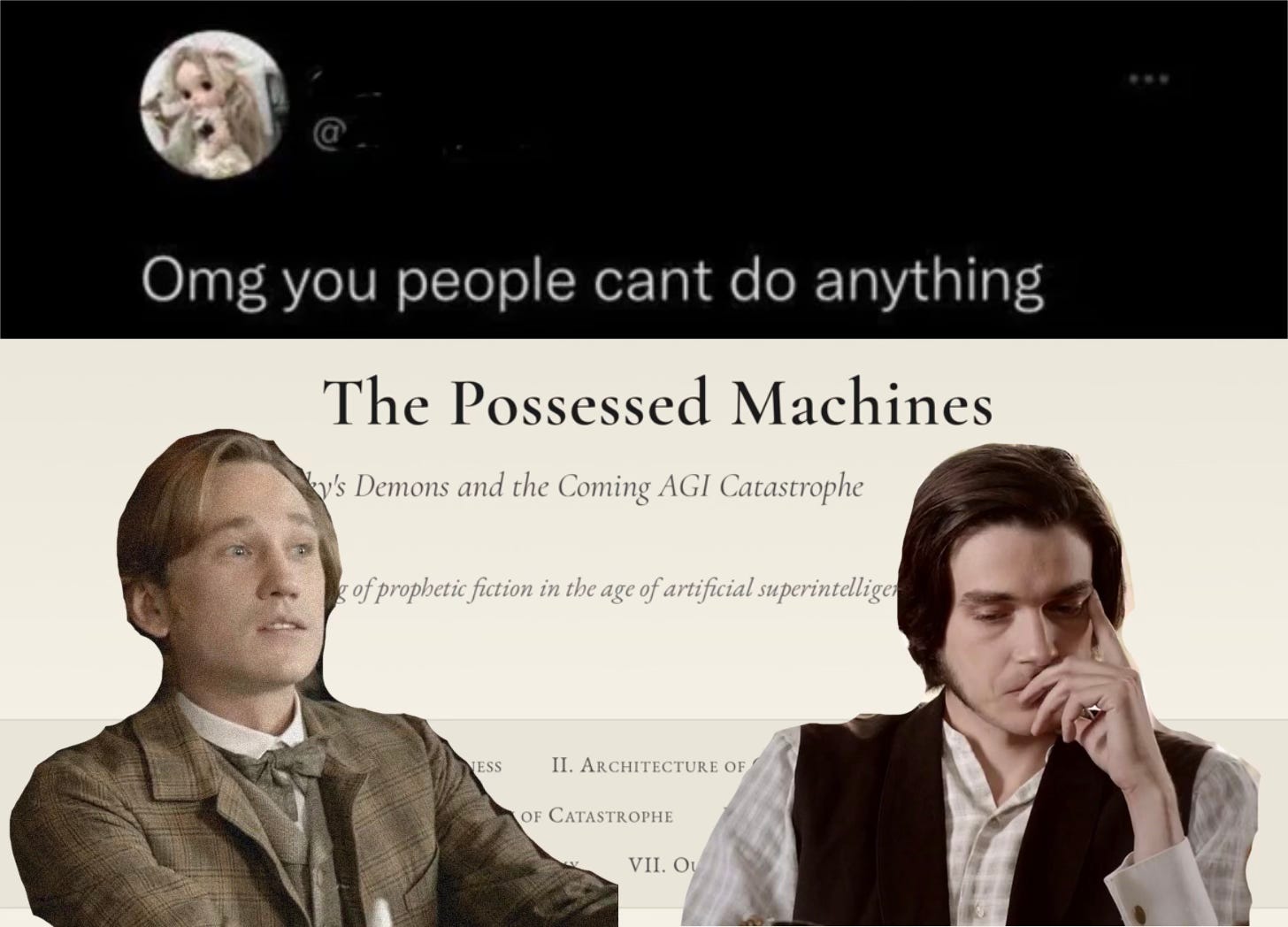
I think the anonymous author of the essay “Possessed Machines” misread the end of the book—particularly, the essayist undersold how pathetic everyone is.
I’m going to spoil this 150-year-old book: Stavrogin kills himself. He skips town and sends Darya Pavlovna a secret letter saying that he has fled to Switzerland, and that Darya Pavlovna should not follow him (but also should follow him), and that he’ll never kill himself, never! But by the time that letter reaches her hand, Nikolay Vsevolodovich Stavrogin has already returned to his mother’s house and killed himself.
And Stavrogin is the least pathetic man1 in the ensemble.
The Dumbest Murder
Let’s piece together Shatov’s murder—expectation versus reality.
Pyotr Stepanovich Verkhovensky wants Shatov dead because he’s a likely informant. Shatov used to be part of their revolutionary society, but during his travels in America, he came to the conclusion that God had chosen the Russian people (on God’s existence, he is less sure), and thus sought to leave the “common cause.” In an attempt at repentance, he sends a letter to the governor offering to sell out the rest of the cell—but only if he gets an immediate pardon and a pension. The governor, a man advised by his doctor not to think too hard, thinks it’s a joke.
But this letter, once in Verkhovensky’s hands, becomes a death warrant. Verkhovensky rounds up the local “group of five” to meet up with Shatov, make him identify the location of a hidden printing press, kill him, and dig up the press to publish inflammatory manifestoes. Verkhovensky thinks this is a two-birds-one-stone affair: not only will this murder eliminate a threat to the “common cause,” but it will also bind the revolutionaries together, preventing future denunciations.
The actual night is a farce. Virginsky gets cold feet and tries to call off the murder. Shigalyov proclaims this murder “stands in contradiction to [his] political programme” and leaves early. Once Shatov marks the hidden location of the printing press, three guys wrestle him to the ground so that Verkhovensky can shoot Shatov in the head. Lyamshin goes feral from the shock, and two other guys hog-tie and gag him to stop his screaming. Once the group disposes of the body, Verkhovensky skips town, figuring that Kirillov’s suicide note “confessing” to the murder will throw the authorities off the trail, and that none of the group of five will confess.
This does not happen. Virginsky immediately tells his wife2 out of guilt, who in turn is smart enough to say nothing and destroy the manifestoes in the house. Shatov’s wife3 immediately asks for her (now-dead) husband, finds Kirillov’s dead body, and puts two and two together, even in a manic delirium. The town authorities find Shatov’s body within the day. Lyamshin cracks, and tells the authorities everything. Virginsky gets arrested and immediately confesses. Two guys skip town, but get caught within two weeks. Shigalyov gets released early, because even the cops conclude he’s all talk and no action.
And they don’t even dig up the printing press.
These People Can’t Do Anything
Like the milieu of the Underground AI Researcher,4 the revolutionary cell (as it appears in Virginsky’s house) ascribes divergent interpretations to notionally common ideas like “socialism,” “the common cause,” or “artificial general intelligence.” Shigalyov has his whole manifesto that ultimately argues that 90% of people only deserve the rights of cattle; Lyamshin escalates by suggesting the extermination of that 90% (mostly as a joke); Verkhovensky later insists “I’m a scoundrel, actually, not a socialist,” simply animated by will-to-power; meanwhile, Kirillov has his own theology of self-will.
But for all my moral disagreements with San Franciscans writ large, they are more intelligent and hardworking than I. They may have bad art taste, poor understanding of the physical world, and none of the noblesse oblige one would ask of an elite, but Claude Code is damn good, and last week, OpenAI finally updated Deep Research with a modern model!
The revolutionaries in Demons do not remind me of AI researchers—they instead remind me of the leftists I hung out with in college. I’ve spent time in Virginsky’s house, complete with the pointless bickering about theory and the motion to actually start the meeting that everyone showed up for. These are not competent people. Shigalyov’s ten-part symposium is theoryslop.5 Kirillov’s theology is a divide-by-zero error that only he falls for.6 Stavrogin, despite his gentleman’s education, is described (twice!) as bad at writing Russian. And when shit gets real, they all prove chicken.
Dostoyevsky’s Red Pill
Fyodor Mikhailovich Dostoyevsky, being a crotchety reactionary, frames the male characters as weak by showing them as subservient to the women in their lives—simps, in modern parlance. Count ‘em up:
Virginsky’s wife Arina Prokhorovna, a local midwife, “retired” him after a year of marriage. She had a child with another man, who ended up moving in for a couple of weeks.
Mavriky Nikolayevich spends the entire story following his betrothed Lizaveta Nikolayevna,7 despite Liza clearly preferring Stavrogin. After the doomed gala, Lizaveta Nikolayevna jumps into Stavrogin’s carriage and follows him into bed, while Mavriky Nikolayevich waits outside Stavrogin’s house in the rain.
The governor cedes his political power (and ultimately sanity) to his wife Yulia Mikhaylovna’s ambitions to be the coolest, hippest liberal in
Stowe, Vermontthe town. As the doomed gala crashes into a town-wide fire, he is reduced to a babbling husk, claiming (correctly, but unhelpfully) that the real fire is in people’s minds.The day before Shatov is killed, his estranged wife Marya Ignatyevna arrives in his house, only to immediately enter labor. Marya Ignatyevna alternately berates him and orders him around, and ultimately cannot decide whether she needs him close or is disgusted by his presence. It is not immediately clear that Shatov, as he kisses his wife’s hands in abject devotion, knows that the child is Stavrogin’s. He dies believing he can finally make it work with his wife and baby son.
And most importantly of all, the Big Man himself, Stepan Trofimovich Verkhovensky, a self-described intellectual with no intellectual output, a quivering Francophile with regular attacks of the vapors, spends two decades in idle debauchery at the sole dependency of his friend (Lover? De facto wife?) Varvara Petrovna. At the start of the story, Varvara Petrovna pressures him into a (later aborted) marriage with her ward Darya Pavlovna, purportedly because she wanted some other woman to take care of him. Only on his deathbed, as he babbles about Christ with the same melodrama that he once opined about Russia’s follies, does he admit that he loved Varvara Petrovna, an admission that Varvara Petrovna swats away with an admonition to shut up.
Of the men with any feminine relationships, they are almost all “whipped,” hapless creatures browbeaten by the women in their lives. If these men, Dostoyevsky wants us to think, cannot stand up to their women, on what basis can they fight for Russia, or even for its demise?
The only man with active sexual magnetism is the human void Nikolay Vsevolodovich Stavrogin. Lizaveta Nikolayevna throws away her reputation for one night in his bed. Darya Pavlovna fawns over him as a “nurse,” convinced that when all this ends, he’ll come back to her. Marya Ignatyevna…well, she and Shatov both idolized Stavrogin in the past.
It’s a bit red-pill, but one must ask the flipside: why do these women stick around with such pathetic men? Varvara Petrovna, Arina Prokhorovna, and Yuliya Mikhaylovna are all independently wealthy, and even Marya Ignatyevna actively refuses Shatov’s pecuniary help. These are liberal women for 1870s Russia, if not outright socialists. They have neither material nor ideological need for any man in their lives, much less quivering weaklings begging on their knees.
And yet…
And Yet They Won
In fairness, Josef Vissarnionovich Stalin had more hair on his chest than Pyotr S. Verkhovensky, but ultimately, he won where Verkhovensky failed, as a scoundrel-socialist who leveraged national disorder into absolute power.
The revolutionaries orbiting Stavrogin and Verkhovensky, our guys наши, do not need to be unified in purpose, or strong in moral fiber, or even particularly competent to lay waste to this town. And as the chaos of the Great Terror suggests, the Bolsheviks didn’t need to be particularly competent at running things to seize (and hold) control of Russia. Although Dostoyevsky died in 1881, long before the demons in this book took national hold, he identified the nation as susceptible.
Take the Orthodox Church, represented by the bizarre holy man Semyon Yakovlevich, a babbling figure surrounded by supplicants, dispensing and withholding “blessings” at a whim, in one case heaping an absurd quantity of sugar (an expensive commodity in 1870s Russia) on one visitor in a perverse admonition to sweeten her heart. Or take the authorities, in the hapless governor whose most forceful rebuttal to a poem that advocates “Vengeance on all of those who seek / To keep up all the old world’s crimes, / Of marriage, church, and family lines!”8 is that the youths are going about things too quickly. Or take the literary establishment in Karmazinov,9 a self-possessed blowhard who has given up on being polite, given up on Russia, given up even on being a good writer as he contributes to the doomed gala with an agonizing reading of his last literary work, entitled—of course—Merci.
This is what remained, in Dostoyevsky’s view, of Russia: a feeble husk of a civilization that, were it not for his love of the land, he would not consider worth saving. The Church no longer held to moral standards, the authorities no longer had the courage to maintain order, the artistic scene cared more about Paris than about ordinary Russians, and the ordinary people were too drunk to ask for anything better.
The revolution didn’t need to be strong: the establishment had decayed so much that a cadre of soyboys could knock down every power center in a town by ruining one gala. All it took was one or two guys to herd these degenerates into a shambling attempt towards revolutionary violence.
I fear the United States in the 2020s is not that much stronger than the Russian Empire in the 1870s. Where have our moral standards gone, religious or secular? How competent have our institutions turned out? And how have our artistic products turned out since, say, Harambe?
I still remember visiting Virginsky’s house in college. Shigalyov was there, Kirillov, Liputin, although Lyamshin had already been expelled for some off-color joke. But no Stavrogin captured that house’s attention, no Verkhovensky whipped that group into real action. Everyone in that house remained harmless.
But that house only needed two guys to start the chain reaction. And the AI engineers that motivated “Possessed Machines” are much more competent conduits for national destruction than the group of five in Demons.
This writing reflects my views alone, and does not reflect the views of my current employer or previous employers. This is not investment advice.
We’ll get to the women
We’ll get to her
We’ll get to her, too
Come on, could you not give yourself a pseudonym for easier reference?
Was Shigalyov “right?” Well, status by its nature has a Pareto curve; it’s not new. The Underground AI Researcher believes his idea lives on in practice: getting entangled in the data; following “reason” to bitter lessons; ultimately leading to a question of one’s own despair. But even then, the concerns of AI Safety luminaries seem as detached from The Normies as Shigalyovism. Did the AI Safety people expect GPT-4o to drive people insane? Did that same cadre of people expect social media to accelerate a genocide, ten years earlier? San Franciscans broadly lack an accurate view of the world outside the Bay, much less of how their world-shaping technologies shape the world.
Camus asks similar questions about self-will and suicide, but he comes to the more normal conclusion to smoke cigarettes, look fly, and have many affairs.
They are not related; they simply both have fathers named Nikolay.
A parody, apparently, of a poem by Nikolai Ogaryov
A parody of a contemporary writer Ivan Turgenev, a dude Dostoyevsky knew in person and personally hated